A recent study from the Gullerova lab at the Sir William Dunn School of Pathology, led by Dr Alagia reveals an important mechanism by which cells repair DNA damage.
Published in Nature Communications, the work highlights the importance of RNA modifications and how the NSUN2 protein is involved in the cellular response to DNA damage.
Cells produce a type of RNA called DARTs (damage-associated RNA transcripts) near the sites of the most toxic type of DNA damage, double-stranded breaks. These RNAs can form R-loops, structures where RNA binds back to the DNA strand, leaving a displaced single strand of DNA. Such R-loops could be a double-edged sword: whilst they can facilitate DNA repair (e.g., by acting as binding platforms for repair factors), they can also cause further DNA damage (if single strand DNA remains exposed), increasing the risk of mutations, and are linked to various diseases including cancer.
Known for its role in adding methyl groups to RNA, NSUN2 influences RNA stability and its interactions with other proteins. Since similar proteins have known roles in repairing DNA damage where R-loops are present, and increased levels of NSUN2 are common in many cancers, this prompted the group to investigate the role of NSUN2 in DNA damage repair.
Employing a variety of state-of-the-art molecular biology techniques, including modified 5-AZA-chromatin immunoprecipitation and Oxford Nanopore Technology for direct RNA sequencing, the team demonstrated a clear interaction between NSUN2, DICER, and R-loops. The findings reveal that NSUN2 is essential for promoting the cleavage of R-loops by the DICER enzyme. When NSUN2 is depleted, cells accumulate DARTs and R-loops around break sites, and DNA repair is delayed. The authors also show that NSUN2’s methylation activity is essential for efficient repair via homologous recombination, a high-fidelity repair pathway. Their results suggest that inhibiting NSUN2 activity and its associated RNA modifications could offer promising therapeutic strategies for conditions linked to DNA damage and R-loop accumulation.
Overall, this work underscores the intricate relationship between RNA modifications and DNA repair mechanisms, showcasing how cells maintain genomic integrity under stress. By highlighting the role of NSUN2 and RNA modifications, the Gullerova lab have opened new avenues for potential treatments for diseases resulting from DNA damage, paving the way for innovative therapeutic approaches.
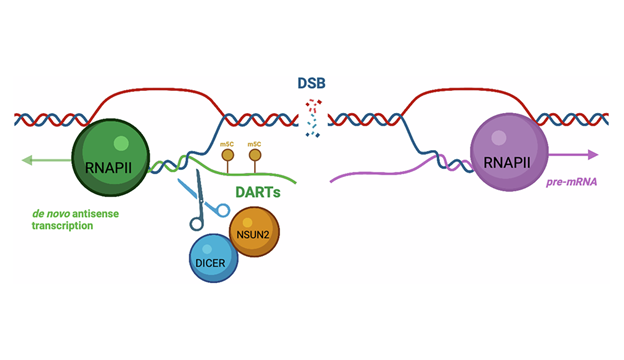
NSUN2 promotes RNA turnover at DNA breaks via DICER-dependent degradation of DARTs.
Source – University of Oxford


A recent study from the Gullerova lab at the Sir William Dunn School of Pathology, led by Dr Alagia reveals an important mechanism by which cells repair DNA damage.
Published in Nature Communications, the work highlights the importance of RNA modifications and how the NSUN2 protein is involved in the cellular response to DNA damage.
Cells produce a type of RNA called DARTs (damage-associated RNA transcripts) near the sites of the most toxic type of DNA damage, double-stranded breaks. These RNAs can form R-loops, structures where RNA binds back to the DNA strand, leaving a displaced single strand of DNA. Such R-loops could be a double-edged sword: whilst they can facilitate DNA repair (e.g., by acting as binding platforms for repair factors), they can also cause further DNA damage (if single strand DNA remains exposed), increasing the risk of mutations, and are linked to various diseases including cancer.
Known for its role in adding methyl groups to RNA, NSUN2 influences RNA stability and its interactions with other proteins. Since similar proteins have known roles in repairing DNA damage where R-loops are present, and increased levels of NSUN2 are common in many cancers, this prompted the group to investigate the role of NSUN2 in DNA damage repair.
Employing a variety of state-of-the-art molecular biology techniques, including modified 5-AZA-chromatin immunoprecipitation and Oxford Nanopore Technology for direct RNA sequencing, the team demonstrated a clear interaction between NSUN2, DICER, and R-loops. The findings reveal that NSUN2 is essential for promoting the cleavage of R-loops by the DICER enzyme. When NSUN2 is depleted, cells accumulate DARTs and R-loops around break sites, and DNA repair is delayed. The authors also show that NSUN2’s methylation activity is essential for efficient repair via homologous recombination, a high-fidelity repair pathway. Their results suggest that inhibiting NSUN2 activity and its associated RNA modifications could offer promising therapeutic strategies for conditions linked to DNA damage and R-loop accumulation.
Overall, this work underscores the intricate relationship between RNA modifications and DNA repair mechanisms, showcasing how cells maintain genomic integrity under stress. By highlighting the role of NSUN2 and RNA modifications, the Gullerova lab have opened new avenues for potential treatments for diseases resulting from DNA damage, paving the way for innovative therapeutic approaches.
NSUN2 promotes RNA turnover at DNA breaks via DICER-dependent degradation of DARTs.
Source – University of Oxford
Alagia A, Ajit K, Di Fazio A, Long Q, Gullerova M. (2025) NSUN2 facilitates DICER cleavage of DNA damage-associated R-loops to promote repair. Nature Communications 16(1): 7882. [article]
Related Posts
RNAmel simplifies RNA sequencing data analysis with a reproducible, integrated platform
Heart failure reshapes bone marrow to create inflammation-related immune memory
Overlooked DNA regions surrounding ‘microexons’ hold missing pieces of autism’s genetic puzzle
RiboBA improves detection of hidden protein-coding regions using ribosome profiling
An anti-senescence gene may fight spinal disc deterioration
Scientists identify the neuroblastoma cells that signal poor outcomes
Novel biosensor uses DNA ‘barcodes’ to uncover disease signals in cells
CellART extracts single-cell information from high-resolution spatial transcriptomics
Cell2space restores spatial context to single-cell RNA sequencing data
Urine test may improve bladder cancer diagnosis and guide treatment decisions
DeCoRE – a computational method to resolve RNA structural heterogeneity from RNA structure probing data by direct RNA sequencing
Tracing 700 million years of cell evolution
How should biological replicates be handled in long-read RNA sequencing?
RNA-Seq reveals a new way the developing heart controls its growth
The Human RNome Project Consortium seeks to publish first-ever complete sequence of the body’s RNA
scFlowReport brings multiple single-cell RNA sequencing analyses into one workflow
Long-read RNA sequencing reveals how neurons choose alternative RNA endings
DeOPUS improves cell-type estimates from bulk RNA sequencing
ResolVI improves accuracy in spatial transcriptomics analysis
RNA sequencing reveals transcriptional allele differences in prostate cancer stem cells
Stay Connected
Submit a Post to the Blog
Recent Posts
Subscribe to the RNA-Seq Blog
RNA-Seq Products & Services