

RNA isn’t just a messenger—it’s a dynamic molecule carrying layers of information that go far beyond the genetic code. In recent years, scientists have discovered that RNA is chemically modified in ways that affect everything from how genes are expressed to how cells respond to stress. These changes—known as epitranscriptomic modifications—include well-known players like m6A (N6-methyladenosine), ψ (pseudouridine), and m5C (5-methylcytosine). Understanding where and how these modifications happen is crucial to unlocking new insights into biology, disease, and potential therapies.
Researchers from Friedrich Schiller University Jena are taking major strides toward this goal. Published in Communications Chemistry, the work centers on the RMaP challenge—a global scientific collaboration designed to improve how we detect RNA modifications using Oxford Nanopore Technologies (ONT), a cutting-edge method for directly sequencing native RNA.
Why is this so exciting? Traditional RNA sequencing can read the sequence of bases—A, C, G, and U—but can’t easily spot chemical modifications. ONT’s direct RNA sequencing, however, reads the native molecule itself, capturing subtle signals when RNA is chemically altered. This raw data contains a treasure trove of hidden information, but unlocking it requires advanced computational tools.
That’s where the RMaP challenge comes in. This initiative brought together bioinformaticians and molecular biologists to compare different algorithms for detecting m6A, ψ, and m5C. The study shows that several of these methods achieved high accuracy and low error rates, highlighting real progress in this fast-growing field.
The RMaP challenge workflow
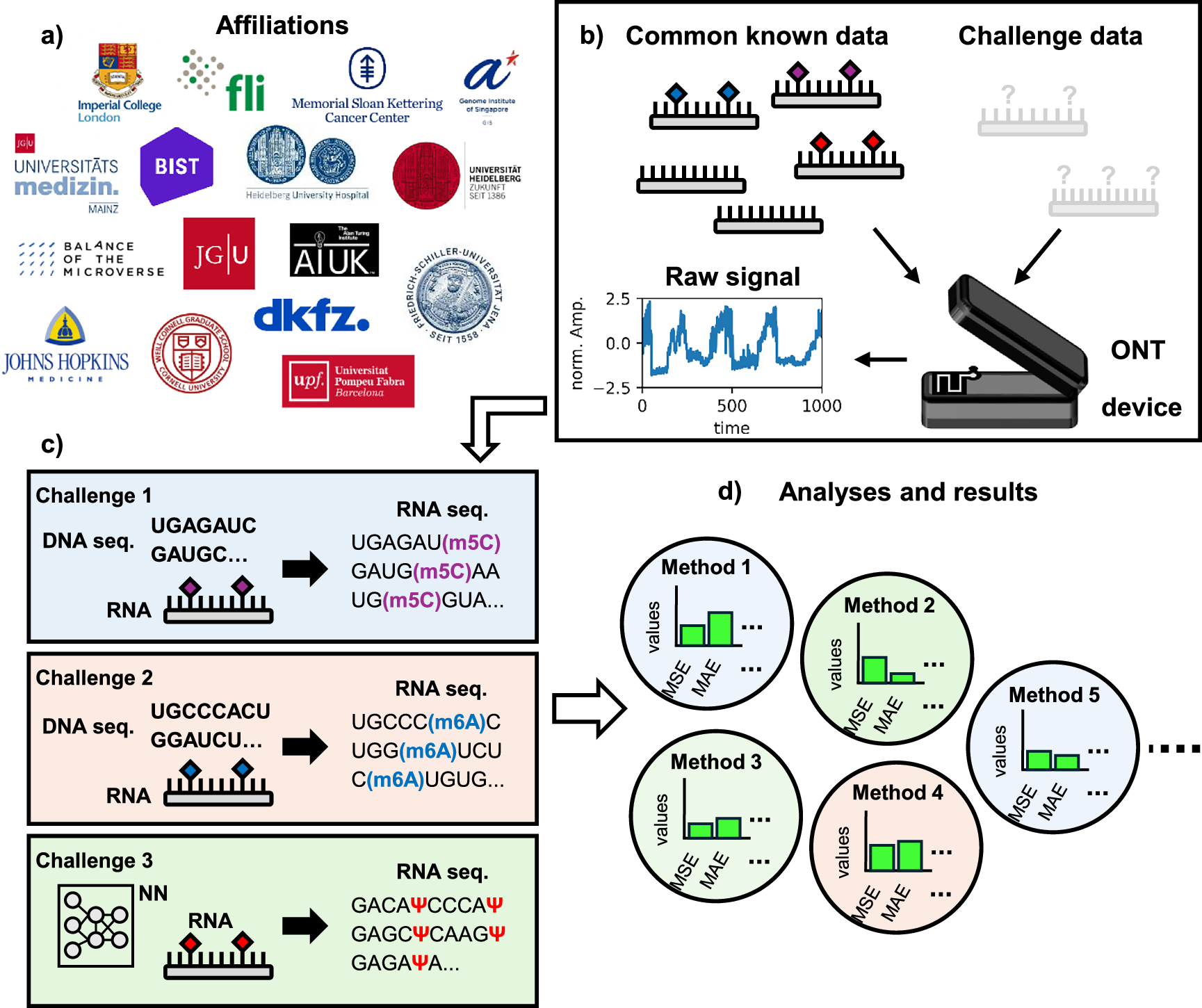
RMaP challenge overview. a The several affiliations that contributed to the RMaP challenge. b Data preparation pipeline for each sub-challenge in RMaP. Datasets were prepared in vitro and measured with ONT. c General overview of the three sub-challenges proposed in RMaP. Each of them proposed a different task for selected RNA modifications. d The results obtained by the new methods are analyzed and compared.
Beyond just benchmarking performance, the challenge helped highlight gaps in the field—areas where detection methods still need refining. As researchers continue to develop better tools and share datasets, the future of epitranscriptomics looks bright.
This work is not just about technology—it’s about fostering collaboration, creating shared standards, and pushing the boundaries of what we can learn from RNA. With ONT sequencing and powerful computational tools, scientists are now better equipped than ever to explore the hidden chemistry of life.
Spangenberg J, Mündnich S, Busch A, Pastore S, Wierczeiko A, Goettsch W, Dietrich V, Pryszcz L P, Cruciani S, Novoa E M, Joshi K, Perera R, Di Giorgio S, Arrubarrena P, Tellioglu I, Poon C L, Wan Y K, Göke J, Hildebrandt A, Dieterich C, Helm M, Marz M, Gerber S, Alagna N. (2025) The RMaP challenge of predicting RNA modifications by nanopore sequencing. Communications Chemistry 8(1): 115. [article]
Related Posts




RNA isn’t just a messenger—it’s a dynamic molecule carrying layers of information that go far beyond the genetic code. In recent years, scientists have discovered that RNA is chemically modified in ways that affect everything from how genes are expressed to how cells respond to stress. These changes—known as epitranscriptomic modifications—include well-known players like m6A (N6-methyladenosine), ψ (pseudouridine), and m5C (5-methylcytosine). Understanding where and how these modifications happen is crucial to unlocking new insights into biology, disease, and potential therapies.
Researchers from Friedrich Schiller University Jena are taking major strides toward this goal. Published in Communications Chemistry, the work centers on the RMaP challenge—a global scientific collaboration designed to improve how we detect RNA modifications using Oxford Nanopore Technologies (ONT), a cutting-edge method for directly sequencing native RNA.
Why is this so exciting? Traditional RNA sequencing can read the sequence of bases—A, C, G, and U—but can’t easily spot chemical modifications. ONT’s direct RNA sequencing, however, reads the native molecule itself, capturing subtle signals when RNA is chemically altered. This raw data contains a treasure trove of hidden information, but unlocking it requires advanced computational tools.
That’s where the RMaP challenge comes in. This initiative brought together bioinformaticians and molecular biologists to compare different algorithms for detecting m6A, ψ, and m5C. The study shows that several of these methods achieved high accuracy and low error rates, highlighting real progress in this fast-growing field.
The RMaP challenge workflow
RMaP challenge overview. a The several affiliations that contributed to the RMaP challenge. b Data preparation pipeline for each sub-challenge in RMaP. Datasets were prepared in vitro and measured with ONT. c General overview of the three sub-challenges proposed in RMaP. Each of them proposed a different task for selected RNA modifications. d The results obtained by the new methods are analyzed and compared.
Beyond just benchmarking performance, the challenge helped highlight gaps in the field—areas where detection methods still need refining. As researchers continue to develop better tools and share datasets, the future of epitranscriptomics looks bright.
This work is not just about technology—it’s about fostering collaboration, creating shared standards, and pushing the boundaries of what we can learn from RNA. With ONT sequencing and powerful computational tools, scientists are now better equipped than ever to explore the hidden chemistry of life.
Spangenberg J, Mündnich S, Busch A, Pastore S, Wierczeiko A, Goettsch W, Dietrich V, Pryszcz L P, Cruciani S, Novoa E M, Joshi K, Perera R, Di Giorgio S, Arrubarrena P, Tellioglu I, Poon C L, Wan Y K, Göke J, Hildebrandt A, Dieterich C, Helm M, Marz M, Gerber S, Alagna N. (2025) The RMaP challenge of predicting RNA modifications by nanopore sequencing. Communications Chemistry 8(1): 115. [article]
Related Posts
Recent Posts
 RNAmel simplifies RNA sequencing data analysis with a reproducible, integrated platform
 Heart failure reshapes bone marrow to create inflammation-related immune memory
 Overlooked DNA regions surrounding ‘microexons’ hold missing pieces of autism’s genetic puzzle
 RiboBA improves detection of hidden protein-coding regions using ribosome profiling
 An anti-senescence gene may fight spinal disc deterioration
 Bulk RNA-seq Analysis: A Complete Beginner’s Guide
RNA-Seq Products & Services



Stay Connected