Amid concerns about the simultaneous spread of multiple respiratory diseases, such as colds and influenza, with the change of seasons in current times, a recent clinical study has scientifically proven that kimchi, a traditional Korean fermented food, enhances the function of human immune cells and maintains the balance of the immune system.
The World Institute of Kimchi, a government-funded research institute under the Ministry of Science and ICT, has reported the results of a single-cell genetic analysis that suggests that kimchi consumption has immunomodulatory effects, which include the suppression of excessive immune responses while simultaneously enhancing defense functions. This is the first study in the world that has elucidated the immunological effects of kimchi at the single-cell level and has shown that kimchi consumption can contribute not only to metabolic health but also to immunological health.
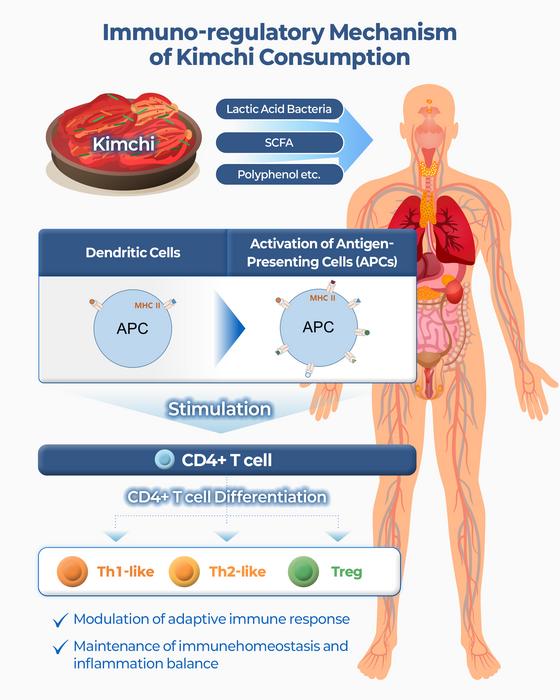
The participants in this study were overweight adults, divided into three groups (n = 13 each). Participants in each group consumed either a placebo, kimchi powder made from naturally fermented kimchi, or kimchi powder made from kimchi fermented with a starter culture for 12 weeks. After the 12-week intervention, peripheral blood mononuclear cells (PBMCs) were collected, and single-cell transcriptomics analysis (scRNA-seq) was conducted. By tracking the changes in the gene expression of each cell using this cutting-edge technique, the research team was able to reveal subtle changes in immune responses that are difficult to detect using conventional tests.
The analysis of the results indicated that in the kimchi-consuming groups, the function of antigen-presenting cells (APCs), which recognize external invaders, such as bacteria and viruses, and transmit signals, was strengthened. Also, the CD4+ T cells differentiated into defense cells and regulatory cells in a balanced manner. These results suggest that kimchi does not just stimulate the immune system, but also acts as a ‘precision regulator’ that enhances the defense capabilities of the immune system if necessary and suppresses unnecessary and excessive responses.
In addition, differences were observed in the immunomodulatory effects according to the kimchi fermentation method used. While both naturally fermented and starter-fermented kimchi had positive effects in maintaining immune balance, the latter showed a more pronounced immunomodulatory effect in terms of strengthening the antigen-recognition ability of immune cells and suppressing unnecessary signals. These results suggest that the health functionality of kimchi can be systematically enhanced using starter technology in the future.
Dr. Woo Jae Lee of the World Institute of Kimchi, who led the research team, said, “Our research has proven for the first time in the world that kimchi has two different simultaneous effects: activating defense cells and suppressing excessive response.” He also emphatically added, “We plan to expand international research on kimchi and lactic acid bacteria in relation to immune and metabolic health in the future.”
The results of this research contribute to establishing kimchi as not just a traditional fermented food but also as a functional food with scientifically proven effects on immune health. The findings of this study are expected to be utilized in various fields, including the development of health functional foods, the improvement of vaccine efficacy, and the prevention of immune diseases.
Source – World Institute of Kimchi


Amid concerns about the simultaneous spread of multiple respiratory diseases, such as colds and influenza, with the change of seasons in current times, a recent clinical study has scientifically proven that kimchi, a traditional Korean fermented food, enhances the function of human immune cells and maintains the balance of the immune system.
The World Institute of Kimchi, a government-funded research institute under the Ministry of Science and ICT, has reported the results of a single-cell genetic analysis that suggests that kimchi consumption has immunomodulatory effects, which include the suppression of excessive immune responses while simultaneously enhancing defense functions. This is the first study in the world that has elucidated the immunological effects of kimchi at the single-cell level and has shown that kimchi consumption can contribute not only to metabolic health but also to immunological health.
The participants in this study were overweight adults, divided into three groups (n = 13 each). Participants in each group consumed either a placebo, kimchi powder made from naturally fermented kimchi, or kimchi powder made from kimchi fermented with a starter culture for 12 weeks. After the 12-week intervention, peripheral blood mononuclear cells (PBMCs) were collected, and single-cell transcriptomics analysis (scRNA-seq) was conducted. By tracking the changes in the gene expression of each cell using this cutting-edge technique, the research team was able to reveal subtle changes in immune responses that are difficult to detect using conventional tests.
The analysis of the results indicated that in the kimchi-consuming groups, the function of antigen-presenting cells (APCs), which recognize external invaders, such as bacteria and viruses, and transmit signals, was strengthened. Also, the CD4+ T cells differentiated into defense cells and regulatory cells in a balanced manner. These results suggest that kimchi does not just stimulate the immune system, but also acts as a ‘precision regulator’ that enhances the defense capabilities of the immune system if necessary and suppresses unnecessary and excessive responses.
In addition, differences were observed in the immunomodulatory effects according to the kimchi fermentation method used. While both naturally fermented and starter-fermented kimchi had positive effects in maintaining immune balance, the latter showed a more pronounced immunomodulatory effect in terms of strengthening the antigen-recognition ability of immune cells and suppressing unnecessary signals. These results suggest that the health functionality of kimchi can be systematically enhanced using starter technology in the future.
The results of this research contribute to establishing kimchi as not just a traditional fermented food but also as a functional food with scientifically proven effects on immune health. The findings of this study are expected to be utilized in various fields, including the development of health functional foods, the improvement of vaccine efficacy, and the prevention of immune diseases.
Source – World Institute of Kimchi
Lee W, Moon HR, Choi H, Lee HJ, Kim Y, Kim HJ, Yun YR, Kwon MS, Hong SW. (2025) Single-cell RNA sequencing reveals that kimchi dietary intervention modulates human antigen-presenting and CD4⁺ T cells. NPJ Science of Food 9(1):236. [article]
Related Posts
Overlooked DNA regions surrounding ‘microexons’ hold missing pieces of autism’s genetic puzzle
RiboBA improves detection of hidden protein-coding regions using ribosome profiling
An anti-senescence gene may fight spinal disc deterioration
Scientists identify the neuroblastoma cells that signal poor outcomes
Novel biosensor uses DNA ‘barcodes’ to uncover disease signals in cells
CellART extracts single-cell information from high-resolution spatial transcriptomics
Cell2space restores spatial context to single-cell RNA sequencing data
Urine test may improve bladder cancer diagnosis and guide treatment decisions
DeCoRE – a computational method to resolve RNA structural heterogeneity from RNA structure probing data by direct RNA sequencing
Tracing 700 million years of cell evolution
How should biological replicates be handled in long-read RNA sequencing?
RNA-Seq reveals a new way the developing heart controls its growth
The Human RNome Project Consortium seeks to publish first-ever complete sequence of the body’s RNA
scFlowReport brings multiple single-cell RNA sequencing analyses into one workflow
Long-read RNA sequencing reveals how neurons choose alternative RNA endings
DeOPUS improves cell-type estimates from bulk RNA sequencing
ResolVI improves accuracy in spatial transcriptomics analysis
RNA sequencing reveals transcriptional allele differences in prostate cancer stem cells
Unmasking “zombie cells” in aging tissue with an AI-powered barcode
RNA variant imaging for cancer diagnosis
Stay Connected
Submit a Post to the Blog
Recent Posts
Subscribe to the RNA-Seq Blog
RNA-Seq Products & Services