Researchers from Brain Research Institute, Niigata University, Japan have revealed that environment influences social behaviours in autism. By using zebrafish that have a mutation in ube3a, a gene linked to Angelman Syndrome (AS) and autism spectrum disorders (ASD), they demonstrated that sensory processing of environmental information is determinant in the outcome of socializing or not. The findings suggest that environmental adjustment could hold therapeutic potential in ASD.
ASD is characterized by difficulties in social interaction and repetitive behaviours. While genetics are known to play an important role, environmental influences are increasingly recognized as crucial modulators of behaviors. Nevertheless, the interactions between environment and genetic predispositions remains largely underexplored.
The team of researchers then used zebrafish carrying a point mutation in the ube3a gene-which shares similarities with AS and ASD-in order to investigate how deep environment affects social behaviours. Social behaviours were investigated in both a custom-made white Styrofoam and a Plexiglass tank environment, alongside conventional anxiety-related tests. Neural activity mapping pre- and post- social interactions, and RNA sequencing were further conducted to uncover underlying mechanisms.
ube3a zebrafish mutants demonstrate environment-dependent social behaviour
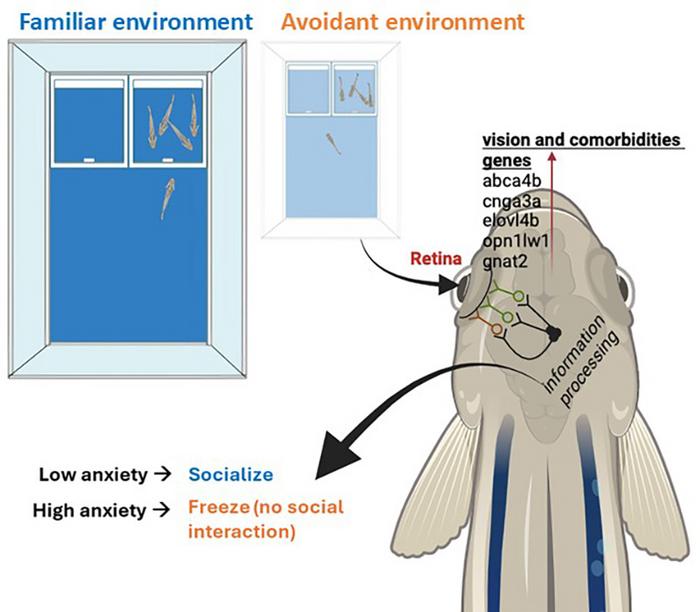
ube3a mutant zebrafish perceive the environmental signal from the retina as a threat or safe, respectively leading to increased or low anxiety levels. When the output is high anxiety levels, as in an aversive environment, social interaction is altered; however, in case the output is low anxiety levels, as in an incentive environment, social behaviors are restored.
The zebrafish have an aversion to white colours and the Styrofoam environment was designed in white to manipulate their sense of anxiety and stress; at the opposite, the Plexiglass was made similar to the fish breeding tanks, thus appeared more familiar and safer.
In an interview, first author Dr Godfried Dougnon, Assistant Professor at the Department of Neuroscience of Disease, Brain Research Institute at Niigata University said: “ube3a mutant zebrafish displayed less time spent in contact to their conspecifics and higher anxiety levels in the stressful Styrofoam container, but these behaviours improved when the test was conducted in a preferred acrylic tank”.
He went on to explain that additional behavioral tests further confirmed higher anxiety-like responses in the mutants.
“Brain activity mapping using c-Fos in situ hybridization showed altered neural activity in specific brain regions, and transcriptomic analysis revealed increased expression of genes related to vision and its comorbidities, as well as abnormalities in sensory pathways”, said senior author Dr Hideaki Matsui, Professor at the same department.
This suggests that abnormal processing of visual information leads to elevated anxiety levels and reduced social interaction in threatening environments, behaviours that are improved in a more familiar setting.
Prof. Hideaki Matsui went on to conclude that: “These findings are important because they provide new clues for approaches to autism, and moreover, they are intriguing in that they suggest that conditions often thought to be uniquely human, such as autism-like disorders, may also exist in fish”.
This study demonstrates that social behavior could be affected by environment in individuals with ASD-related genetic predispositions. These results open new therapeutic perspectives, indicating that tailoring environmental stimuli could maybe help improve some ASD-related behavioural challenges. Future work will aim to translate these findings into human, and develop environment-based intervention strategies.
Source – Niigata University


Researchers from Brain Research Institute, Niigata University, Japan have revealed that environment influences social behaviours in autism. By using zebrafish that have a mutation in ube3a, a gene linked to Angelman Syndrome (AS) and autism spectrum disorders (ASD), they demonstrated that sensory processing of environmental information is determinant in the outcome of socializing or not. The findings suggest that environmental adjustment could hold therapeutic potential in ASD.
ASD is characterized by difficulties in social interaction and repetitive behaviours. While genetics are known to play an important role, environmental influences are increasingly recognized as crucial modulators of behaviors. Nevertheless, the interactions between environment and genetic predispositions remains largely underexplored.
The team of researchers then used zebrafish carrying a point mutation in the ube3a gene-which shares similarities with AS and ASD-in order to investigate how deep environment affects social behaviours. Social behaviours were investigated in both a custom-made white Styrofoam and a Plexiglass tank environment, alongside conventional anxiety-related tests. Neural activity mapping pre- and post- social interactions, and RNA sequencing were further conducted to uncover underlying mechanisms.
ube3a zebrafish mutants demonstrate environment-dependent social behaviour
ube3a mutant zebrafish perceive the environmental signal from the retina as a threat or safe, respectively leading to increased or low anxiety levels. When the output is high anxiety levels, as in an aversive environment, social interaction is altered; however, in case the output is low anxiety levels, as in an incentive environment, social behaviors are restored.
The zebrafish have an aversion to white colours and the Styrofoam environment was designed in white to manipulate their sense of anxiety and stress; at the opposite, the Plexiglass was made similar to the fish breeding tanks, thus appeared more familiar and safer.
He went on to explain that additional behavioral tests further confirmed higher anxiety-like responses in the mutants.
This suggests that abnormal processing of visual information leads to elevated anxiety levels and reduced social interaction in threatening environments, behaviours that are improved in a more familiar setting.
This study demonstrates that social behavior could be affected by environment in individuals with ASD-related genetic predispositions. These results open new therapeutic perspectives, indicating that tailoring environmental stimuli could maybe help improve some ASD-related behavioural challenges. Future work will aim to translate these findings into human, and develop environment-based intervention strategies.
Source – Niigata University
Dougnon G, Matsui H. (2025) Environmental context modulates sociability in ube3a zebrafish mutants via alterations in sensory pathways. Molecular Psychiatry [Epub ahead of print]. [article]
Related Posts
Novel biosensor uses DNA ‘barcodes’ to uncover disease signals in cells
CellART extracts single-cell information from high-resolution spatial transcriptomics
Cell2space restores spatial context to single-cell RNA sequencing data
Urine test may improve bladder cancer diagnosis and guide treatment decisions
DeCoRE – a computational method to resolve RNA structural heterogeneity from RNA structure probing data by direct RNA sequencing
Tracing 700 million years of cell evolution
How should biological replicates be handled in long-read RNA sequencing?
RNA-Seq reveals a new way the developing heart controls its growth
The Human RNome Project Consortium seeks to publish first-ever complete sequence of the body’s RNA
scFlowReport brings multiple single-cell RNA sequencing analyses into one workflow
Long-read RNA sequencing reveals how neurons choose alternative RNA endings
DeOPUS improves cell-type estimates from bulk RNA sequencing
ResolVI improves accuracy in spatial transcriptomics analysis
RNA sequencing reveals transcriptional allele differences in prostate cancer stem cells
Unmasking “zombie cells” in aging tissue with an AI-powered barcode
RNA variant imaging for cancer diagnosis
Autism-risk mutations reveal two opposing patterns of brain gene activity
A real-data approach to evaluating RNA transcript analysis methods
Detection and sequencing of Ap2N-capped RNAs in human cells
Single-cell RNA sequencing provides a closer look at the Aedes aegypti midgut
Stay Connected
Submit a Post to the Blog
Recent Posts
Subscribe to the RNA-Seq Blog
RNA-Seq Products & Services