A new AI tool helps identify hidden similarities across distant species.
Why do traditional genetic tools struggle to compare distant species?
Scientists often compare cells using single-cell RNA sequencing, which shows which genes are active in each cell. When carried out across an organism, this information can be used to build a “cell tree”, mapping different cell types and their activity.
However, most comparison tools rely on direct one-to-one gene matches. These matches become harder to find as species diverge over time, meaning important biological similarities (for example, between immune cells in humans and mice, or neurons in fish and flies) may be missed.
How can AI reveal similarities between cells separated by evolution?
To overcome these limitations, Unify compares the jobs that genes perform. Where conventional methods resemble dictionaries seeking word-for-word translations, this tool looks for shared biological meaning.
“Unify works with AI models that analyze protein sequences and scientific descriptions of gene functions,” explains Huawen Zhong, lead author and computational biologist at KAUST. “Genes with certain similarities are grouped into units called ‘macrogenes’. This allows Unify to recognize cells performing similar jobs, even when their individual genes no longer match.”
The Unify framework for balanced cross-species integration
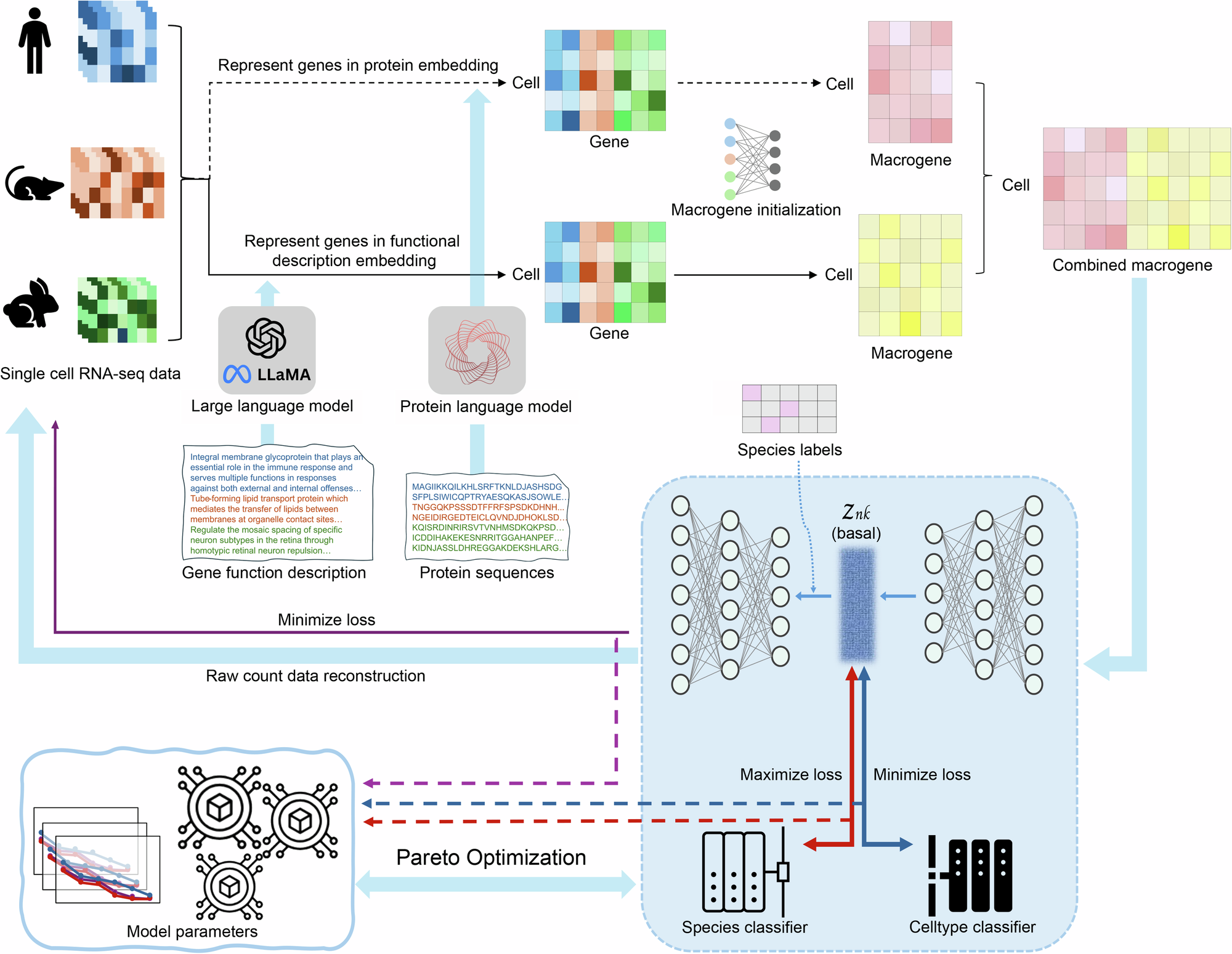
The Unify workflow consists of two main stages. (Top Panel) First, Unify constructs multi-modal macrogenes by integrating gene representations from two complementary sources: (1) structural properties, derived from protein language models (e.g., ESM-2), and (2) functional context, derived from large language models (e.g., LLaMA-2). (Bottom Panel) These macrogenes then serve as input for an adversarial autoencoder. A Pareto-optimal multi-task learning strategy guides the training process to systematically balance three competing objectives: robust batch correction (mixing species), the preservation of conserved biological signals (aligning cell types), and the reconstruction of input data (capturing the cellular state). The final output is a unified cell embedding space that enables accurate and robust cross-species comparisons.
What hidden genetic relationships did Unify uncover?
Unify reconstructed relationships among 125 cell types from seven species separated by more than 700 million years. It distinguished between identical genes, similar genes that had evolved new jobs, and different genes that had evolved independently to do the same job.
By analyzing immune cells across multiple species, Unify identified shared defense tactics that would be difficult to detect using methods restricted to direct gene comparison. In another experiment, it predicted the response of human blood cells to a certain immune-signaling protein, based on the response of mouse lymph-node immune cells. Across all genes, Unify’s predictions were more accurate than existing methods.
What are the next steps in mapping cell evolution?
The KAUST team is now extending Unify to include information about gene regulation and cell positions within tissues. These additions will give researchers a fuller picture of the biological principles shared across life, informing further advances in human health research.
By combining biological knowledge with AI, Unify can identify patterns at a scale that would take researchers far longer to find through gene-by-gene comparisons.
Its impact is summed up by KAUST Professor of Marine Science Manuel Aranda, “A lot of what we know about human biology comes from studying animals like mice, but it is not always clear which findings carry over. Unify helps us identify which discoveries in model organisms are most likely to be relevant to humans, so research can be focused where it is most useful for understanding human health and disease.”
Source – KAUST
Availability – The source code is available at GitHub [https://github.com/huawen-poppy/Unify].


A new AI tool helps identify hidden similarities across distant species.
Why do traditional genetic tools struggle to compare distant species?
Scientists often compare cells using single-cell RNA sequencing, which shows which genes are active in each cell. When carried out across an organism, this information can be used to build a “cell tree”, mapping different cell types and their activity.
However, most comparison tools rely on direct one-to-one gene matches. These matches become harder to find as species diverge over time, meaning important biological similarities (for example, between immune cells in humans and mice, or neurons in fish and flies) may be missed.
How can AI reveal similarities between cells separated by evolution?
To overcome these limitations, Unify compares the jobs that genes perform. Where conventional methods resemble dictionaries seeking word-for-word translations, this tool looks for shared biological meaning.
The Unify framework for balanced cross-species integration
The Unify workflow consists of two main stages. (Top Panel) First, Unify constructs multi-modal macrogenes by integrating gene representations from two complementary sources: (1) structural properties, derived from protein language models (e.g., ESM-2), and (2) functional context, derived from large language models (e.g., LLaMA-2). (Bottom Panel) These macrogenes then serve as input for an adversarial autoencoder. A Pareto-optimal multi-task learning strategy guides the training process to systematically balance three competing objectives: robust batch correction (mixing species), the preservation of conserved biological signals (aligning cell types), and the reconstruction of input data (capturing the cellular state). The final output is a unified cell embedding space that enables accurate and robust cross-species comparisons.
What hidden genetic relationships did Unify uncover?
Unify reconstructed relationships among 125 cell types from seven species separated by more than 700 million years. It distinguished between identical genes, similar genes that had evolved new jobs, and different genes that had evolved independently to do the same job.
By analyzing immune cells across multiple species, Unify identified shared defense tactics that would be difficult to detect using methods restricted to direct gene comparison. In another experiment, it predicted the response of human blood cells to a certain immune-signaling protein, based on the response of mouse lymph-node immune cells. Across all genes, Unify’s predictions were more accurate than existing methods.
What are the next steps in mapping cell evolution?
The KAUST team is now extending Unify to include information about gene regulation and cell positions within tissues. These additions will give researchers a fuller picture of the biological principles shared across life, informing further advances in human health research.
By combining biological knowledge with AI, Unify can identify patterns at a scale that would take researchers far longer to find through gene-by-gene comparisons.
Source – KAUST
Availability – The source code is available at GitHub [https://github.com/huawen-poppy/Unify].
Zhong H, Han W, Cui G, Gomez-Cabrero D, Tegner J, Gao X, Aranda M. (2026) Unify learns cellular evolution with universal multimodal embeddings Nature Communications 17(1): 9290. [article]
Related Posts
UMIche – a UMI-centric analysis platform for enhancing molecular quantification accuracy in bulk and single-cell sequencing
New RNA sequencing tool reveals how stem cells develop into heart cells
Estimating the completeness of large-scale single-cell sequencing projects
New RNA sequencing tool improves transcriptome reconstruction using machine learning
DeMixNB: deconvolution of sparse-count RNA sequencing data for tumor cells
New RNA sequencing method improves tRNA analysis using deep learning
Researchers create first whole-body single-cell atlas of an adult vertebrate
UAlbany Joins $10 Million Effort to Map RNA Modifications in the Human Body
SpliceCOV improves RNA sequencing analysis by filtering transcriptional noise
Overlooked ‘off switch’ in lung tumors may explain why immunotherapy doesn’t work for everyone
Squids Edit RNA for Novel Protein Functions
New marker panel and web tool help define early human cell fates
RNA sequencing reveals molecular changes driving right ventricular heart failure
Researchers Develop AI Tool to Map MicroRNA Binding Sites on Circular RNAs
Single-cell RNA sequencing reveals the diversity of human neutrophils across health and disease
Yale researchers improve RNA extraction from precision-cut lung slices
RNA sequencing reveals how genes combine to regulate inflammation and immune responses
RNAffinityDB – a curated database of experimental RNA–protein binding affinities
“Raman Genome” for SARS-CoV-2: new Raman technology distinguishes viral variants by their molecular RNA architecture
Advanced paternal age has sex-specific effects on fetal brain gene expression
Stay Connected
Submit a Post to the Blog
Recent Posts
Subscribe to the RNA-Seq Blog
RNA-Seq Products & Services