


The adult zebrafish heart has an unusual ability to repair itself after injury. Unlike the adult human heart, which often heals with scar tissue after a heart attack, zebrafish can replace damaged heart tissue and restore function. Scientists have long wanted to understand the earliest signals that launch this repair process.
Researchers at the Max Delbrück Center for Molecular Medicine used an approach called in vivo single-cell RNA metabolic labeling to study heart regeneration in adult zebrafish. This method marks newly made RNA inside living animals, allowing researchers to see which genes turn on shortly after injury and which cell types respond first.
Traditional RNA sequencing can show which genes are active, but it often captures a mix of older and newer RNA molecules. RNA metabolic labeling adds timing information by marking newly produced RNA. When combined with single-cell RNA sequencing, it gives a more precise view of how individual cells respond during the first hours after injury.
SLAM-seq labels transcription in the adult zebrafish heart
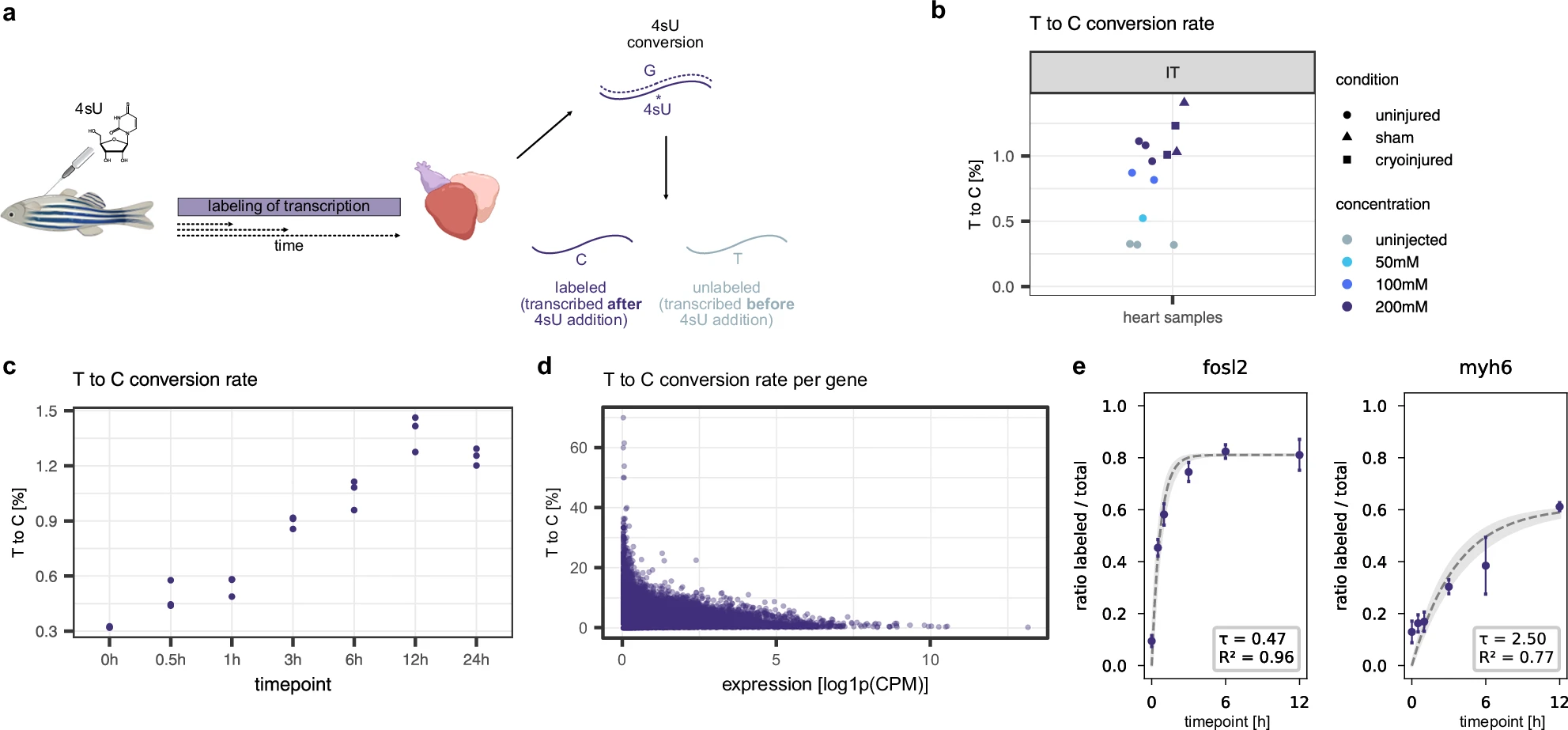
a Schematic bulk SLAM-seq experimental workflow. b T-to-C conversion rates of heart samples from IT injected zebrafish with different 4sU concentrations. Each dot represents one sample, n = 3 (uninjected), n = 1 (50 mM), n = 2 (100 mM), n = 3 (200 mM, uninjured), n = 2 (200 mM, sham), n = 2 (200 mM, cryoinjured). Data of uninjected samples was acquired in the context of the SLAM-seq time course in panel c and re-used for visualization purposes. c T-to-C conversion rates of SLAM-seq time course after a single 4sU injection. Each dot represents one sample, with each time point being acquired in biological triplicates. d T-to-C conversion rate per gene as a function of expression after 6 h of labeling (sample 1). CPM…counts per million, log1p…natural logarithm of 1 plus the input value. e Two representative genes (left: fosl2, right: myh6) from the SLAM-seq time course. Dots indicate average labeled to total reads ratio among biological triplicates, error bars indicate standard deviation, dashed line indicates fitted curve, gray shaded area represents 95% confidence interval, τ values are the estimated RNA half-lives in hours.
Using this strategy, the team found that important immune signals appear very early, within the first six hours after heart injury. A subset of macrophage-like immune cells activated innate immune programs, including Toll-like receptor signaling. Analysis of a larger single-cell dataset also suggested that neutrophils contribute to the early response.
These findings are important because inflammation can be both helpful and harmful. The immune system must respond quickly to injury, but too much inflammatory signaling can interfere with repair. By focusing on specific immune cells, the researchers were able to examine whether this early response could be adjusted.
Guided by the RNA sequencing data, the team inhibited MyD88, a key adaptor protein in Toll-like receptor signaling, specifically in macrophages. This reduced the pro-inflammatory macrophage response at the injury site and improved early signs of regeneration, including blood vessel growth and heart muscle cell proliferation.
The work shows that immune cells are not just cleanup crews after injury. They can help set the stage for regeneration, and their activity may need to be carefully balanced. In zebrafish, fine-tuning macrophage inflammatory signaling appears to improve early repair responses.
This approach also highlights the value of single-cell RNA metabolic labeling for studying fast biological events in living animals. By tracking newly made RNA at single-cell resolution, researchers can capture early gene activity that may be missed by standard methods.
Although zebrafish hearts regenerate far better than human hearts, understanding the early signals that guide their repair may help researchers identify strategies for improving healing after cardiac injury in other species.
Mintcheva J, Tseng T, Goumenaki P, Neuschulz A, Senoussi A, Lelek S, Lim K, Ming Z, Schäfer R, Hnatiuk A, Ninov N, Beisaw A, McGrail M, Lai S, Panáková D, Stainier D, Junker J. (2026) In vivo single-cell RNA metabolic labeling resolves early transcriptional responders in the regenerating zebrafish heart. Nature Communications 17(1): 4073. [article]
Related Posts






The adult zebrafish heart has an unusual ability to repair itself after injury. Unlike the adult human heart, which often heals with scar tissue after a heart attack, zebrafish can replace damaged heart tissue and restore function. Scientists have long wanted to understand the earliest signals that launch this repair process.
Researchers at the Max Delbrück Center for Molecular Medicine used an approach called in vivo single-cell RNA metabolic labeling to study heart regeneration in adult zebrafish. This method marks newly made RNA inside living animals, allowing researchers to see which genes turn on shortly after injury and which cell types respond first.
Traditional RNA sequencing can show which genes are active, but it often captures a mix of older and newer RNA molecules. RNA metabolic labeling adds timing information by marking newly produced RNA. When combined with single-cell RNA sequencing, it gives a more precise view of how individual cells respond during the first hours after injury.
SLAM-seq labels transcription in the adult zebrafish heart
a Schematic bulk SLAM-seq experimental workflow. b T-to-C conversion rates of heart samples from IT injected zebrafish with different 4sU concentrations. Each dot represents one sample, n = 3 (uninjected), n = 1 (50 mM), n = 2 (100 mM), n = 3 (200 mM, uninjured), n = 2 (200 mM, sham), n = 2 (200 mM, cryoinjured). Data of uninjected samples was acquired in the context of the SLAM-seq time course in panel c and re-used for visualization purposes. c T-to-C conversion rates of SLAM-seq time course after a single 4sU injection. Each dot represents one sample, with each time point being acquired in biological triplicates. d T-to-C conversion rate per gene as a function of expression after 6 h of labeling (sample 1). CPM…counts per million, log1p…natural logarithm of 1 plus the input value. e Two representative genes (left: fosl2, right: myh6) from the SLAM-seq time course. Dots indicate average labeled to total reads ratio among biological triplicates, error bars indicate standard deviation, dashed line indicates fitted curve, gray shaded area represents 95% confidence interval, τ values are the estimated RNA half-lives in hours.
Using this strategy, the team found that important immune signals appear very early, within the first six hours after heart injury. A subset of macrophage-like immune cells activated innate immune programs, including Toll-like receptor signaling. Analysis of a larger single-cell dataset also suggested that neutrophils contribute to the early response.
These findings are important because inflammation can be both helpful and harmful. The immune system must respond quickly to injury, but too much inflammatory signaling can interfere with repair. By focusing on specific immune cells, the researchers were able to examine whether this early response could be adjusted.
Guided by the RNA sequencing data, the team inhibited MyD88, a key adaptor protein in Toll-like receptor signaling, specifically in macrophages. This reduced the pro-inflammatory macrophage response at the injury site and improved early signs of regeneration, including blood vessel growth and heart muscle cell proliferation.
The work shows that immune cells are not just cleanup crews after injury. They can help set the stage for regeneration, and their activity may need to be carefully balanced. In zebrafish, fine-tuning macrophage inflammatory signaling appears to improve early repair responses.
This approach also highlights the value of single-cell RNA metabolic labeling for studying fast biological events in living animals. By tracking newly made RNA at single-cell resolution, researchers can capture early gene activity that may be missed by standard methods.
Although zebrafish hearts regenerate far better than human hearts, understanding the early signals that guide their repair may help researchers identify strategies for improving healing after cardiac injury in other species.
Mintcheva J, Tseng T, Goumenaki P, Neuschulz A, Senoussi A, Lelek S, Lim K, Ming Z, Schäfer R, Hnatiuk A, Ninov N, Beisaw A, McGrail M, Lai S, Panáková D, Stainier D, Junker J. (2026) In vivo single-cell RNA metabolic labeling resolves early transcriptional responders in the regenerating zebrafish heart. Nature Communications 17(1): 4073. [article]
Related Posts
Recent Posts
 Scientists identify the neuroblastoma cells that signal poor outcomes
 GARAGE improves rare cell detection in single-cell RNA sequencing analysis using AI
 Machine learning reveals how RNA splicing is regulated in individual cell types
 Illumina releases SpliceAI2 to help advance rare disease research
 Postdoctoral Fellow – Long-Read RNA Methods Development for Neurodegeneration
 Novel biosensor uses DNA ‘barcodes’ to uncover disease signals in cells
RNA-Seq Products & Services



Stay Connected