

Researchers at Rice University have developed an innovative RNA-based method to track how genes move between microbes in complex environments like wastewater. This new approach, called universal RNA barcoding, enables scientists to study microbial gene transfer with far greater sensitivity than traditional genetic reporters or sequencing methods.
To achieve this, the team engineered a synthetic catalytic RNA (ribozyme) that can “write” unique barcodes into ribosomal RNA (rRNA), a fundamental component of microbial cells. By using RNA sequencing, they could then “read” these barcodes to determine which microbes had acquired specific genes. Their analysis of wastewater microbiomes revealed that bacteria from 20 different taxonomic orders were involved in plasmid conjugation—a process by which bacteria exchange genetic material.
RAM is an efficient barcoding technology that functions across diverse microorganisms
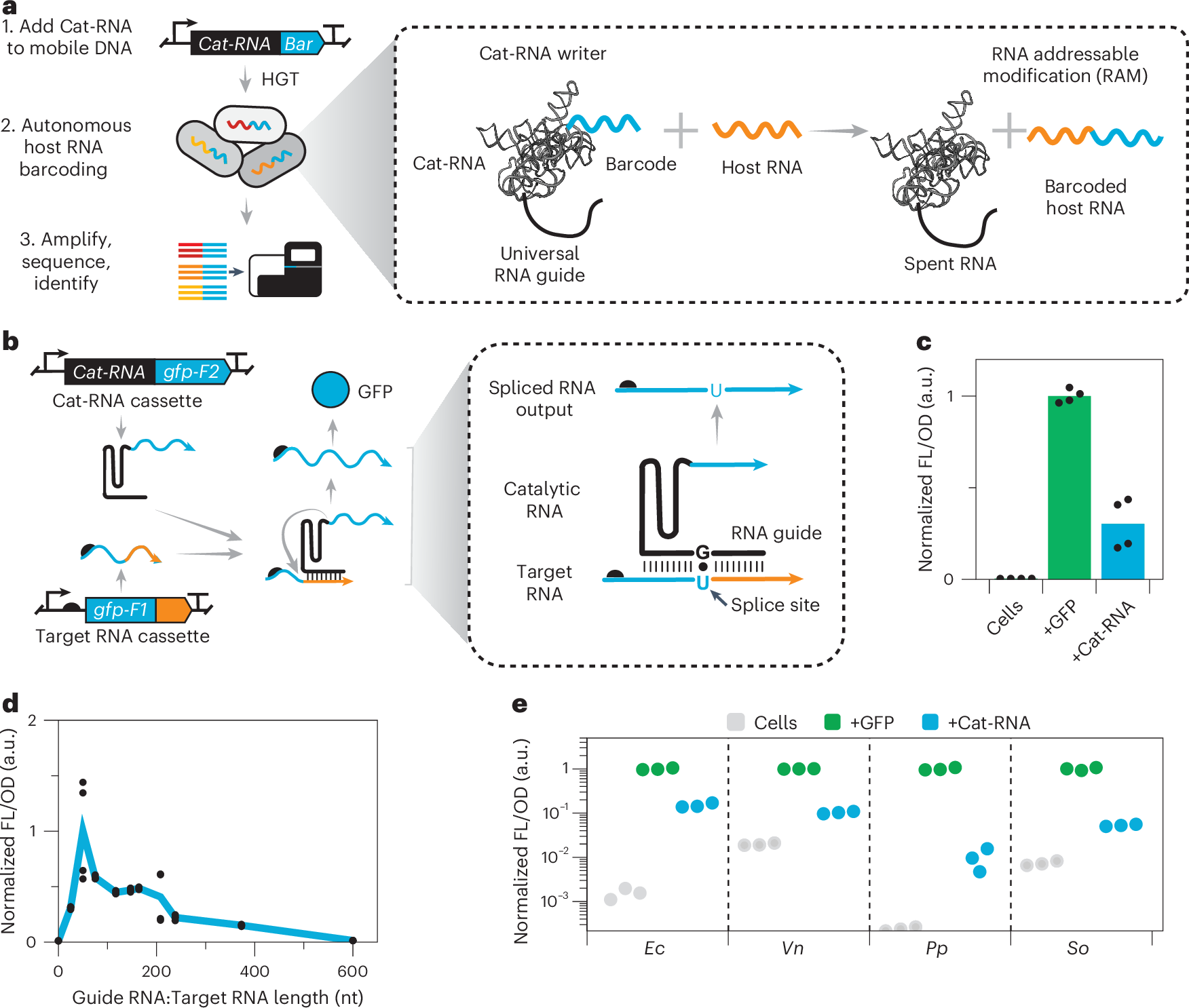
a, RAM uses a cat-RNA to splice synthetic RNA barcodes onto host RNA to record mobile DNA uptake by horizontal gene transfer (HGT). b, A fluorescence assay was created that uses cat-RNA barcoding of a target RNA to produce an mRNA product that is competent for translating GFP. c, Fluorescence of E. coli expressing the cat-RNA reporter (+cat-RNA) or a constitutively expressed GFP-positive control (+GFP) compared to cells harboring an empty vector (cells). The signal from cat-RNA is significantly higher than that from the vector control (Mann–Whitney one-tailed, unpaired U-test, P = 0.014). FL/OD, ratio of fluorescence to OD; a.u., arbitrary units. d, RNA guide length affects the reporter signal. RNA guides and corresponding target RNA, ranging from 25 to 373 nt, present signals that are significantly higher than a cat-RNA design lacking a guide (Mann–Whitney one-tailed, unpaired U-test on pooled data, P = 0.01). Replicates are shown as points while the line connects average values. e, Fluorescence characterization of the visual reporter with a 50-nt guide in E. coli (Ec), V. natriegens (Vn), P. putida (Pp) and S. oneidensis (So). All cells present fluorescence (+cat-RNA) that is significantly higher than that of the negative control (cells), similar to the positive control (+GFP) (Welch’s one-tailed, unpaired t-test, P = 0.002, 0.001, 0.045 and 0.0003 for each organism, respectively). Data represent four biological replicates in c,d and three biological replicates in e.
Moreover, by introducing plasmids with different origins of replication (pBBR1 and ColE1), the researchers discovered variations in how different microbes accepted foreign DNA. This technique offers a powerful tool for studying microbiome engineering, tracking gene flow in natural environments, and understanding how bacteria acquire traits like antibiotic resistance.
By eliminating the need for protein translation, this RNA-addressable modification method provides a direct and autonomous way to study microbial gene transfer. It has exciting implications for microbiome research, environmental monitoring, and synthetic biology.
Kalvapalle PB, Staubus A, Dysart MJ, Gambill L, Reyes Gamas K, Lu LC, Silberg JJ, Stadler LB, Chappell J. (2025) Information storage across a microbial community using universal RNA barcoding. Nat Biotechnol [Epub ahead of print]. [article]
Related Posts




Researchers at Rice University have developed an innovative RNA-based method to track how genes move between microbes in complex environments like wastewater. This new approach, called universal RNA barcoding, enables scientists to study microbial gene transfer with far greater sensitivity than traditional genetic reporters or sequencing methods.
To achieve this, the team engineered a synthetic catalytic RNA (ribozyme) that can “write” unique barcodes into ribosomal RNA (rRNA), a fundamental component of microbial cells. By using RNA sequencing, they could then “read” these barcodes to determine which microbes had acquired specific genes. Their analysis of wastewater microbiomes revealed that bacteria from 20 different taxonomic orders were involved in plasmid conjugation—a process by which bacteria exchange genetic material.
RAM is an efficient barcoding technology that functions across diverse microorganisms
a, RAM uses a cat-RNA to splice synthetic RNA barcodes onto host RNA to record mobile DNA uptake by horizontal gene transfer (HGT). b, A fluorescence assay was created that uses cat-RNA barcoding of a target RNA to produce an mRNA product that is competent for translating GFP. c, Fluorescence of E. coli expressing the cat-RNA reporter (+cat-RNA) or a constitutively expressed GFP-positive control (+GFP) compared to cells harboring an empty vector (cells). The signal from cat-RNA is significantly higher than that from the vector control (Mann–Whitney one-tailed, unpaired U-test, P = 0.014). FL/OD, ratio of fluorescence to OD; a.u., arbitrary units. d, RNA guide length affects the reporter signal. RNA guides and corresponding target RNA, ranging from 25 to 373 nt, present signals that are significantly higher than a cat-RNA design lacking a guide (Mann–Whitney one-tailed, unpaired U-test on pooled data, P = 0.01). Replicates are shown as points while the line connects average values. e, Fluorescence characterization of the visual reporter with a 50-nt guide in E. coli (Ec), V. natriegens (Vn), P. putida (Pp) and S. oneidensis (So). All cells present fluorescence (+cat-RNA) that is significantly higher than that of the negative control (cells), similar to the positive control (+GFP) (Welch’s one-tailed, unpaired t-test, P = 0.002, 0.001, 0.045 and 0.0003 for each organism, respectively). Data represent four biological replicates in c,d and three biological replicates in e.
Moreover, by introducing plasmids with different origins of replication (pBBR1 and ColE1), the researchers discovered variations in how different microbes accepted foreign DNA. This technique offers a powerful tool for studying microbiome engineering, tracking gene flow in natural environments, and understanding how bacteria acquire traits like antibiotic resistance.
By eliminating the need for protein translation, this RNA-addressable modification method provides a direct and autonomous way to study microbial gene transfer. It has exciting implications for microbiome research, environmental monitoring, and synthetic biology.
Kalvapalle PB, Staubus A, Dysart MJ, Gambill L, Reyes Gamas K, Lu LC, Silberg JJ, Stadler LB, Chappell J. (2025) Information storage across a microbial community using universal RNA barcoding. Nat Biotechnol [Epub ahead of print]. [article]
Related Posts
Recent Posts
 Novel biosensor uses DNA ‘barcodes’ to uncover disease signals in cells
 GP-DHT uses single-cell RNA sequencing to map gene regulatory networks
 Boehringer taps Envisagenics’ AI to mine RNA splicing for cancer targets
 CellART extracts single-cell information from high-resolution spatial transcriptomics
 Cell2space restores spatial context to single-cell RNA sequencing data
 PacBio and TychoBio Collaborate to Train AI Models for Rare Disease
RNA-Seq Products & Services


Stay Connected