

CRISPR technology has made it possible to systematically explore the effects of turning genes on or off, and when paired with RNA sequencing, it allows researchers to see how those genetic changes affect the entire transcriptome—essentially, a full snapshot of gene activity in a cell. One popular approach, called Perturb-seq, enables scientists to perform thousands of these experiments at once, each on a single cell. But there’s a catch: the data can be noisy, and many of the more subtle changes go unnoticed.
Now, researchers from multiple institutions, led by researchers from Harvard Medical School, have introduced a statistical model called TRADE—short for transcriptome-wide analysis of differential expression. TRADE helps separate real gene expression changes from background noise by taking into account the uncertainty in measurements. This allows scientists to better estimate what they call the “transcriptome-wide impact” of each gene perturbation.
Transcriptome-wide analysis of differential expression
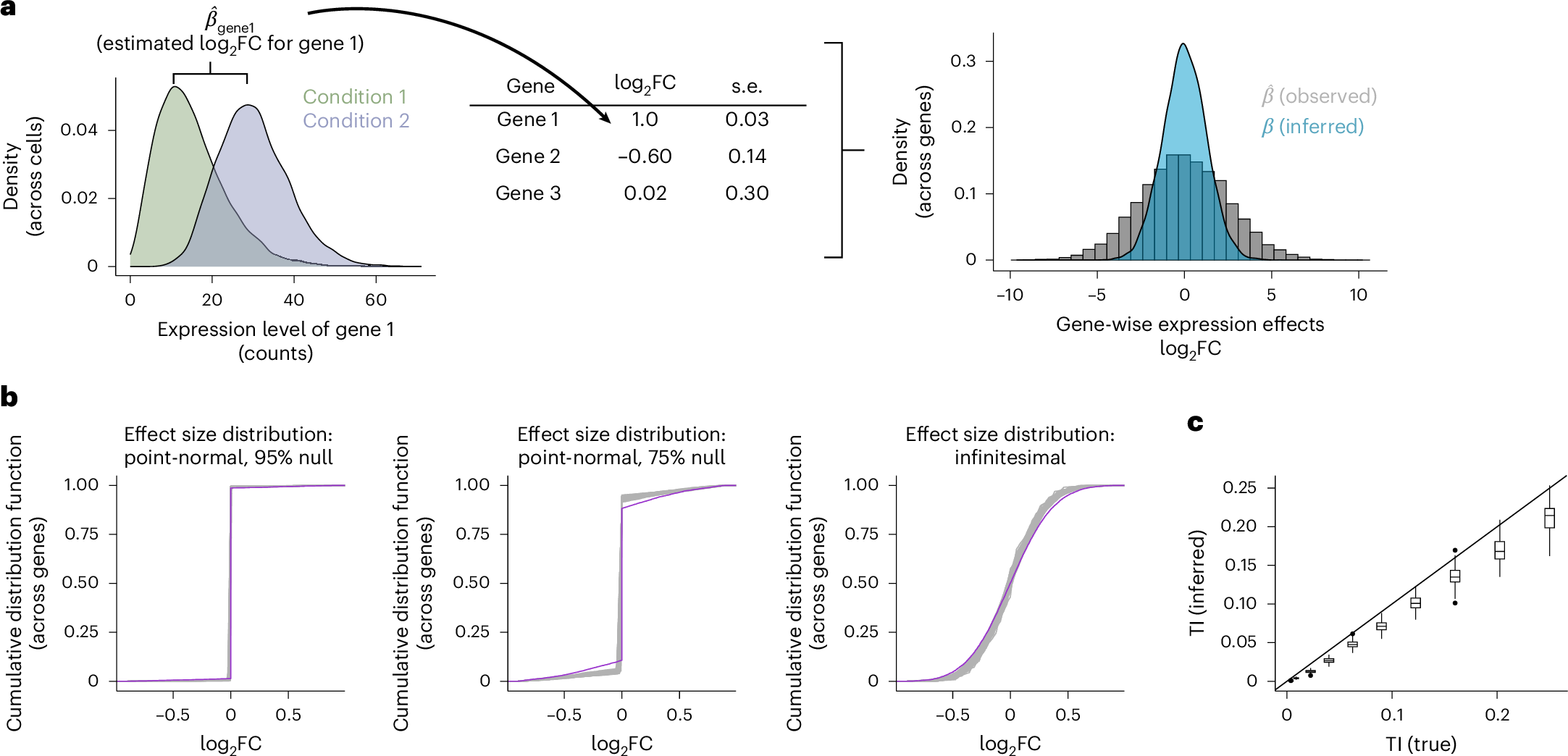
a, Schematic for TRADE analysis, starting from condition-wise gene expression counts and ending with estimated distribution of log2FC. b, Estimation of various simulated effect size distributions (point-normal with 95% null, point-normal with 75% null, infinitesimal/normally distributed). Purple traces, true effect size distribution; gray traces, estimated distributions across 100 replicates. c, Comparison of estimated and true TI in simulations. Each boxplot is composed of 100 independent simulations. FC, fold change; s.e., standard error.
When they applied TRADE to several large Perturb-seq datasets, the results were striking. On average, tweaking a single gene affected around 45 other genes—but essential genes, which are critical for cell survival, influenced over 500 genes. TRADE also revealed how the effects of some gene changes differ depending on dosage and how those effects vary across different cell types. In addition, the researchers used the tool to explore how gene expression shifts relate to genetic risk factors in neuropsychiatric conditions like schizophrenia and autism.
TRADE doesn’t just sharpen our ability to detect changes—it gives scientists a broader view of how genes interact across the transcriptome, helping uncover biological insights that would otherwise remain hidden in the noise.
Availability – The TRADE method, with accompanying documentation, is publicly available as an R package at https://github.com/ajaynadig/TRADEtools.
Nadig A, Replogle JM, Pogson AN, Murthy M, McCarroll SA, Weissman JS, Robinson EB, O’Connor LJ. (2025) Transcriptome-wide analysis of differential expression in perturbation atlases. Nature Genetics [Epub ahead of print]. [article]
Related Posts




CRISPR technology has made it possible to systematically explore the effects of turning genes on or off, and when paired with RNA sequencing, it allows researchers to see how those genetic changes affect the entire transcriptome—essentially, a full snapshot of gene activity in a cell. One popular approach, called Perturb-seq, enables scientists to perform thousands of these experiments at once, each on a single cell. But there’s a catch: the data can be noisy, and many of the more subtle changes go unnoticed.
Now, researchers from multiple institutions, led by researchers from Harvard Medical School, have introduced a statistical model called TRADE—short for transcriptome-wide analysis of differential expression. TRADE helps separate real gene expression changes from background noise by taking into account the uncertainty in measurements. This allows scientists to better estimate what they call the “transcriptome-wide impact” of each gene perturbation.
Transcriptome-wide analysis of differential expression
a, Schematic for TRADE analysis, starting from condition-wise gene expression counts and ending with estimated distribution of log2FC. b, Estimation of various simulated effect size distributions (point-normal with 95% null, point-normal with 75% null, infinitesimal/normally distributed). Purple traces, true effect size distribution; gray traces, estimated distributions across 100 replicates. c, Comparison of estimated and true TI in simulations. Each boxplot is composed of 100 independent simulations. FC, fold change; s.e., standard error.
When they applied TRADE to several large Perturb-seq datasets, the results were striking. On average, tweaking a single gene affected around 45 other genes—but essential genes, which are critical for cell survival, influenced over 500 genes. TRADE also revealed how the effects of some gene changes differ depending on dosage and how those effects vary across different cell types. In addition, the researchers used the tool to explore how gene expression shifts relate to genetic risk factors in neuropsychiatric conditions like schizophrenia and autism.
TRADE doesn’t just sharpen our ability to detect changes—it gives scientists a broader view of how genes interact across the transcriptome, helping uncover biological insights that would otherwise remain hidden in the noise.
Availability – The TRADE method, with accompanying documentation, is publicly available as an R package at https://github.com/ajaynadig/TRADEtools.
Nadig A, Replogle JM, Pogson AN, Murthy M, McCarroll SA, Weissman JS, Robinson EB, O’Connor LJ. (2025) Transcriptome-wide analysis of differential expression in perturbation atlases. Nature Genetics [Epub ahead of print]. [article]
Related Posts
Recent Posts
 Novel biosensor uses DNA ‘barcodes’ to uncover disease signals in cells
 GP-DHT uses single-cell RNA sequencing to map gene regulatory networks
 Boehringer taps Envisagenics’ AI to mine RNA splicing for cancer targets
 CellART extracts single-cell information from high-resolution spatial transcriptomics
 Cell2space restores spatial context to single-cell RNA sequencing data
 PacBio and TychoBio Collaborate to Train AI Models for Rare Disease
RNA-Seq Products & Services


Stay Connected