“TraMA is likely to be of particular value to researchers interested in understanding the biological processes underlying health and aging, and for social, psychological, epidemiological, and demographic studies of health and aging.”
In this study, led by Eric T. Klopack from the University of Southern California, researchers created a new RNA-based aging measure that predicts health risks and mortality. This measure, called Transcriptomic Mortality-risk Age (TraMA), uses gene expression data to estimate a person’s biological aging. This finding offers a new and potentially more accurate way to track aging and understand health risks, especially for older adults.
Aging is a complex biological process that affects multiple systems in the body and increases the risk of disease and death. Scientists have long looked for reliable ways to measure biological aging. While DNA methylation and blood biomarkers are commonly used, this study focused on RNA—a molecule that reflects gene activity. By analyzing RNA sequencing data from nearly 4,000 U.S. adults aged 50 and older, the team developed TraMA to predict the probability of dying within four years.
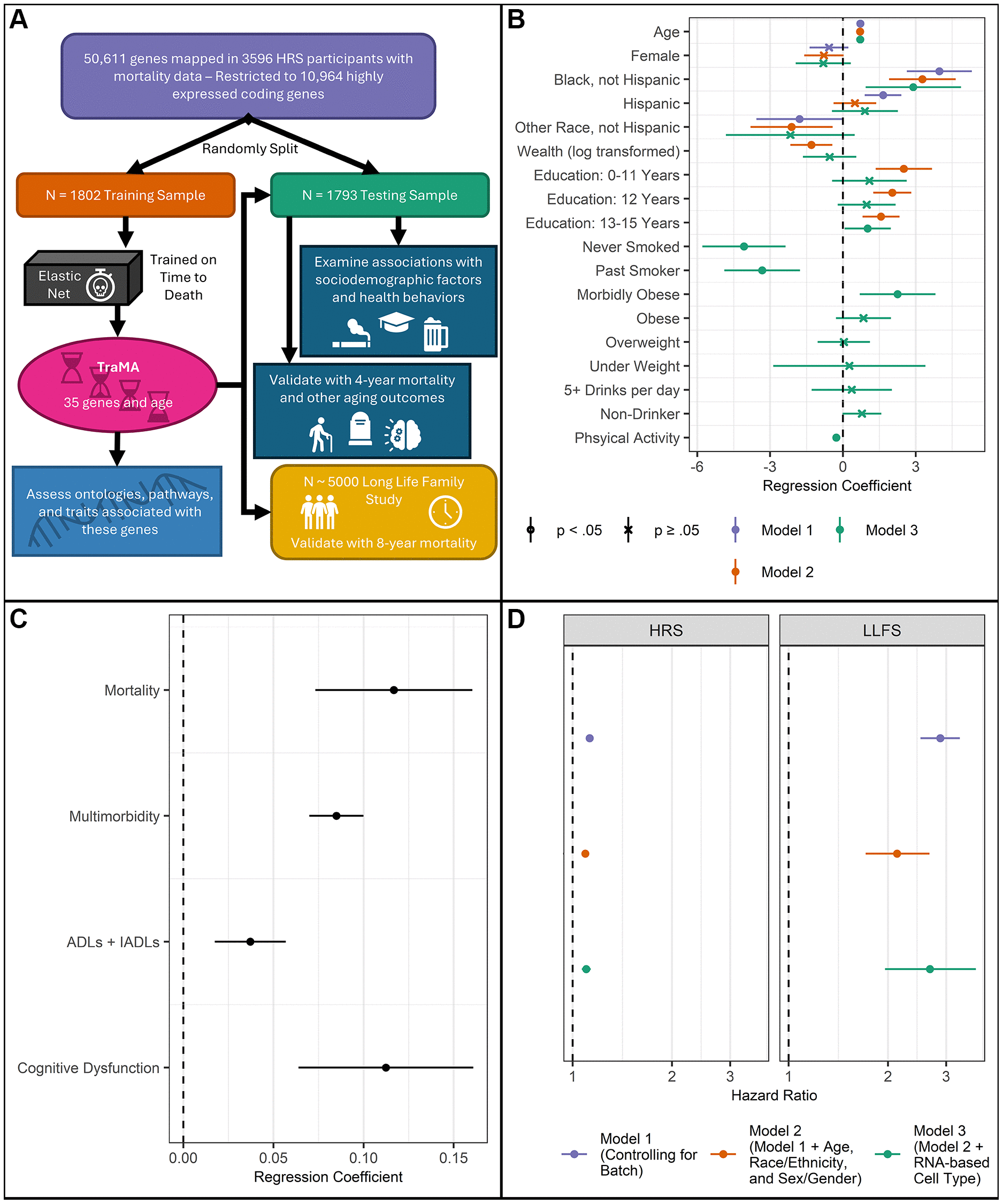
(A) Plan of analysis for the current study. (B) Nested regression results from the HRS testing data including associations between TraMA and sociodemographic factors and health behaviors; points represent regression coefficients and bars represent 95% confidence intervals; all models include cell type and batch as covariates. Model 1 includes demographic factors; Model 2 includes variables in Model 1, as well as socioeconomic factors; Model 3 includes variables in Model 2, as well as health behaviors. (C) Regression results from the HRS testing data of health/aging outcomes on TraMA; points represent regression coefficients and bars represent 95% confidence intervals; all models include age, race/ethnicity, sex/gender, cell type, and batch as covariates. (D). Validation results from nested regression of time to death on TraMA in HRS and LLFS. Model 1 includes batch as a covariate; Model 2 includes batch, age, race/ethnicity, and sex/gender as covariates; Model 3 includes variables from Model 2, as well as RNA-based cell type as covariates.
TraMA proved to be a strong and independent predictor of early death, multiple chronic diseases, poor cognitive function, and difficulties with daily activities. It was also tested in another large group of long-lived families and in several smaller datasets from patients with conditions like diabetes, sepsis, and cancer. The results confirmed the tool’s usefulness across different populations and health conditions.
“TraMA was also externally validated in the Long Life Family Study and several publicly available datasets.”
Unlike earlier RNA-based aging measures, which were often built using small or non-representative samples, TraMA was developed using modern RNA sequencing technology results and a nationally representative dataset. This increases its reliability and potential for broad public health applications. The tool also demonstrated unique advantages over popular biological aging measures like GrimAge and PhenoAge, capturing distinct aspects of aging and health decline.
Importantly, TraMA tracks biological processes related to inflammation, immune function, and kidney and brain health, systems that play key roles in aging. It was also sensitive to behavioral and socioeconomic factors. For instance, smoking, obesity, and low physical activity were associated with older TraMA scores.
TraMA was also sensitive to changes in biological aging. In one study, researchers measured TraMA at two different time points and found that the more recent scores were better at predicting who would die. This suggests that TraMA can track changes in a person’s aging as their health evolves. It also performed well in both large-scale surveys and small clinical samples, making it a useful tool in many types of research.
By offering a new, accurate, and flexible method for measuring biological aging, TraMA may help researchers better understand how genes, lifestyle, and environment influence aging. This tool opens the door to more precise research on improving health and extending lifespan.
Source – Impact Journals


In this study, led by Eric T. Klopack from the University of Southern California, researchers created a new RNA-based aging measure that predicts health risks and mortality. This measure, called Transcriptomic Mortality-risk Age (TraMA), uses gene expression data to estimate a person’s biological aging. This finding offers a new and potentially more accurate way to track aging and understand health risks, especially for older adults.
Aging is a complex biological process that affects multiple systems in the body and increases the risk of disease and death. Scientists have long looked for reliable ways to measure biological aging. While DNA methylation and blood biomarkers are commonly used, this study focused on RNA—a molecule that reflects gene activity. By analyzing RNA sequencing data from nearly 4,000 U.S. adults aged 50 and older, the team developed TraMA to predict the probability of dying within four years.
(A) Plan of analysis for the current study. (B) Nested regression results from the HRS testing data including associations between TraMA and sociodemographic factors and health behaviors; points represent regression coefficients and bars represent 95% confidence intervals; all models include cell type and batch as covariates. Model 1 includes demographic factors; Model 2 includes variables in Model 1, as well as socioeconomic factors; Model 3 includes variables in Model 2, as well as health behaviors. (C) Regression results from the HRS testing data of health/aging outcomes on TraMA; points represent regression coefficients and bars represent 95% confidence intervals; all models include age, race/ethnicity, sex/gender, cell type, and batch as covariates. (D). Validation results from nested regression of time to death on TraMA in HRS and LLFS. Model 1 includes batch as a covariate; Model 2 includes batch, age, race/ethnicity, and sex/gender as covariates; Model 3 includes variables from Model 2, as well as RNA-based cell type as covariates.
TraMA proved to be a strong and independent predictor of early death, multiple chronic diseases, poor cognitive function, and difficulties with daily activities. It was also tested in another large group of long-lived families and in several smaller datasets from patients with conditions like diabetes, sepsis, and cancer. The results confirmed the tool’s usefulness across different populations and health conditions.
Unlike earlier RNA-based aging measures, which were often built using small or non-representative samples, TraMA was developed using modern RNA sequencing technology results and a nationally representative dataset. This increases its reliability and potential for broad public health applications. The tool also demonstrated unique advantages over popular biological aging measures like GrimAge and PhenoAge, capturing distinct aspects of aging and health decline.
Importantly, TraMA tracks biological processes related to inflammation, immune function, and kidney and brain health, systems that play key roles in aging. It was also sensitive to behavioral and socioeconomic factors. For instance, smoking, obesity, and low physical activity were associated with older TraMA scores.
TraMA was also sensitive to changes in biological aging. In one study, researchers measured TraMA at two different time points and found that the more recent scores were better at predicting who would die. This suggests that TraMA can track changes in a person’s aging as their health evolves. It also performed well in both large-scale surveys and small clinical samples, making it a useful tool in many types of research.
By offering a new, accurate, and flexible method for measuring biological aging, TraMA may help researchers better understand how genes, lifestyle, and environment influence aging. This tool opens the door to more precise research on improving health and extending lifespan.
Source – Impact Journals
Klopack E, Seshadri G, Arpawong T, Cole S, Thyagarajan B, Crimmins E. (2025) Development of a novel transcriptomic measure of aging: Transcriptomic Mortality-risk Age (TraMA). Aging (Albany NY) 17(6): 1521–1543. [article]
Related Posts
Novel biosensor uses DNA ‘barcodes’ to uncover disease signals in cells
CellART extracts single-cell information from high-resolution spatial transcriptomics
Cell2space restores spatial context to single-cell RNA sequencing data
Urine test may improve bladder cancer diagnosis and guide treatment decisions
DeCoRE – a computational method to resolve RNA structural heterogeneity from RNA structure probing data by direct RNA sequencing
Tracing 700 million years of cell evolution
How should biological replicates be handled in long-read RNA sequencing?
RNA-Seq reveals a new way the developing heart controls its growth
The Human RNome Project Consortium seeks to publish first-ever complete sequence of the body’s RNA
scFlowReport brings multiple single-cell RNA sequencing analyses into one workflow
Long-read RNA sequencing reveals how neurons choose alternative RNA endings
DeOPUS improves cell-type estimates from bulk RNA sequencing
ResolVI improves accuracy in spatial transcriptomics analysis
RNA sequencing reveals transcriptional allele differences in prostate cancer stem cells
Unmasking “zombie cells” in aging tissue with an AI-powered barcode
RNA variant imaging for cancer diagnosis
Autism-risk mutations reveal two opposing patterns of brain gene activity
A real-data approach to evaluating RNA transcript analysis methods
Detection and sequencing of Ap2N-capped RNAs in human cells
Single-cell RNA sequencing provides a closer look at the Aedes aegypti midgut
Stay Connected
Submit a Post to the Blog
Recent Posts
Subscribe to the RNA-Seq Blog
RNA-Seq Products & Services