

Understanding how individual bacterial cells behave—even when they’re part of the same population—has always been a challenge. But thanks to advances in single-cell RNA sequencing (scRNA-seq), researchers can now listen in on the gene activity of single bacteria like never before.
In a new study led by researchers at the University of Würzburg, researchers introduced a detailed and reliable protocol for profiling individual bacteria using a method called MATQ-seq (multiple annealing and dC-tailing-based quantitative scRNA-seq). Originally developed for studying eukaryotic cells, this approach has now been successfully adapted for bacterial cells, allowing scientists to capture gene expression data even when working with very small sample sizes.
Overview of the MATQ-seq workflow
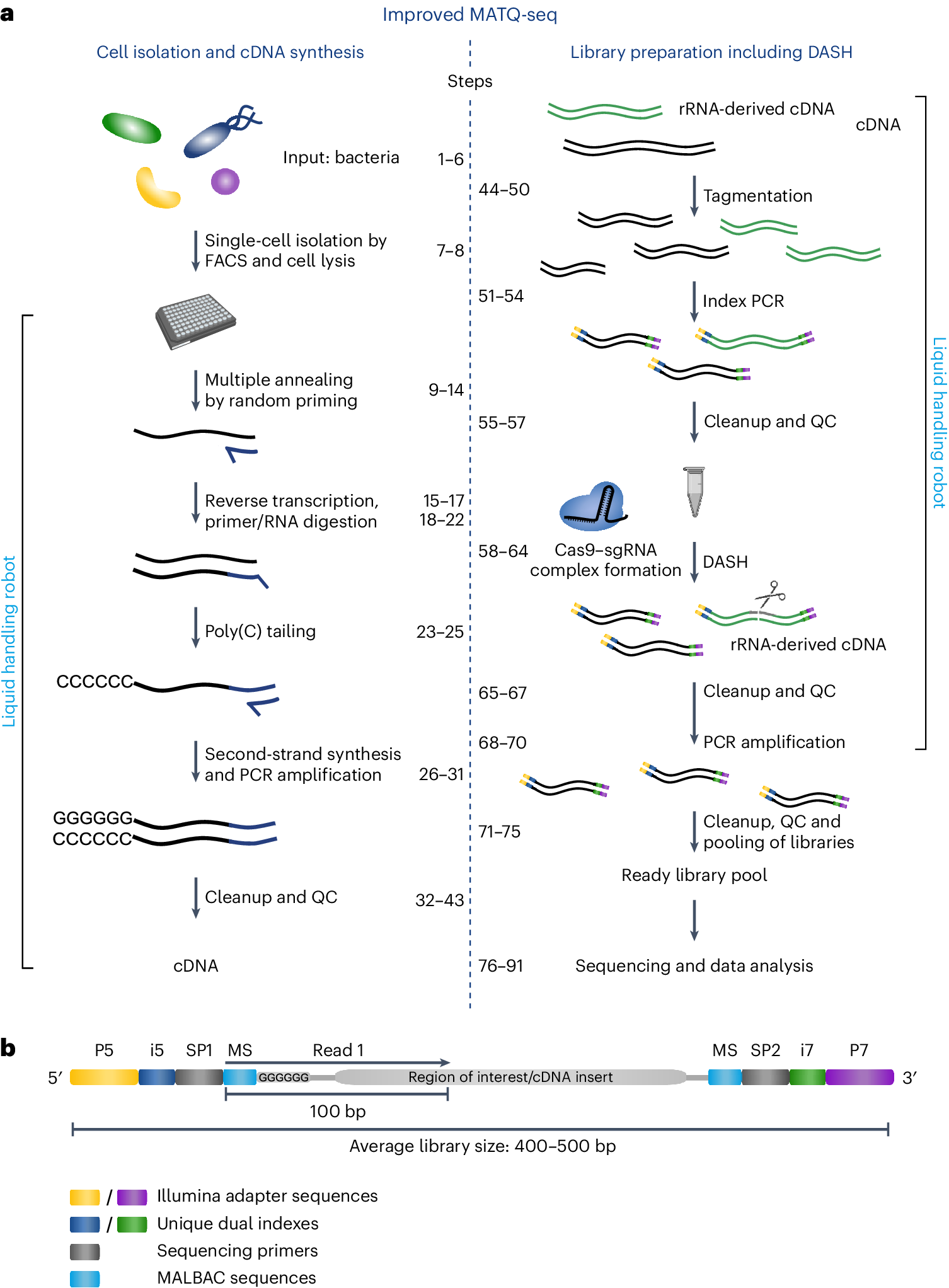
a, The workflow is structured into two main steps: cell isolation and cDNA synthesis (left) and library preparation including DASH for rRNA depletion (right). All pipetting steps can be automated using a liquid handling robot, except for all cleanup and QC steps. b, Illustration of the final MATQ-seq library using the Illumina Nextera XT library preparation kit. In addition to the region of interest containing the RNA-derived cDNA, the library includes Illumina and MATQ-seq specific sequences derived from dual indices, sequencing adapters and MALBAC primers. Sample indexing and demultiplexing is based on unique dual indexes implemented during the index PCR. The scheme illustrates sequencing in single-end mode for read 1, using 100 cycles.
What makes this method stand out is its high cell retention rate—95% of sorted bacterial cells are successfully converted into useful sequencing libraries. This is a major improvement over other protocols, especially when working with limited or delicate samples. The workflow involves a five-day process including cell sorting, robotic handling, rRNA removal, and sequencing. Notably, the method consistently detects between 300 to 600 genes per single bacterial cell.
Using model organisms like Salmonella enterica, the team demonstrated that MATQ-seq provides a clear and comprehensive look into the bacterial transcriptome. This opens the door for more refined studies on microbial behavior, antibiotic resistance, and the dynamics within complex microbial communities.
As this robust technique is already proving effective across several bacterial species, MATQ-seq is shaping up to be a cornerstone method in microbial single-cell studies.
Homberger C, Imdahl F, Hayward R J, Barquist L, Saliba A E, Vogel J. (2025) Transcriptomic profiling of individual bacteria by MATQ-seq. Nature Protocols [Epub ahead of print]. [article]
Related Posts




Understanding how individual bacterial cells behave—even when they’re part of the same population—has always been a challenge. But thanks to advances in single-cell RNA sequencing (scRNA-seq), researchers can now listen in on the gene activity of single bacteria like never before.
In a new study led by researchers at the University of Würzburg, researchers introduced a detailed and reliable protocol for profiling individual bacteria using a method called MATQ-seq (multiple annealing and dC-tailing-based quantitative scRNA-seq). Originally developed for studying eukaryotic cells, this approach has now been successfully adapted for bacterial cells, allowing scientists to capture gene expression data even when working with very small sample sizes.
Overview of the MATQ-seq workflow
a, The workflow is structured into two main steps: cell isolation and cDNA synthesis (left) and library preparation including DASH for rRNA depletion (right). All pipetting steps can be automated using a liquid handling robot, except for all cleanup and QC steps. b, Illustration of the final MATQ-seq library using the Illumina Nextera XT library preparation kit. In addition to the region of interest containing the RNA-derived cDNA, the library includes Illumina and MATQ-seq specific sequences derived from dual indices, sequencing adapters and MALBAC primers. Sample indexing and demultiplexing is based on unique dual indexes implemented during the index PCR. The scheme illustrates sequencing in single-end mode for read 1, using 100 cycles.
What makes this method stand out is its high cell retention rate—95% of sorted bacterial cells are successfully converted into useful sequencing libraries. This is a major improvement over other protocols, especially when working with limited or delicate samples. The workflow involves a five-day process including cell sorting, robotic handling, rRNA removal, and sequencing. Notably, the method consistently detects between 300 to 600 genes per single bacterial cell.
Using model organisms like Salmonella enterica, the team demonstrated that MATQ-seq provides a clear and comprehensive look into the bacterial transcriptome. This opens the door for more refined studies on microbial behavior, antibiotic resistance, and the dynamics within complex microbial communities.
As this robust technique is already proving effective across several bacterial species, MATQ-seq is shaping up to be a cornerstone method in microbial single-cell studies.
Homberger C, Imdahl F, Hayward R J, Barquist L, Saliba A E, Vogel J. (2025) Transcriptomic profiling of individual bacteria by MATQ-seq. Nature Protocols [Epub ahead of print]. [article]
Related Posts
Recent Posts
 Scientists identify the neuroblastoma cells that signal poor outcomes
 GARAGE improves rare cell detection in single-cell RNA sequencing analysis using AI
 Machine learning reveals how RNA splicing is regulated in individual cell types
 Illumina releases SpliceAI2 to help advance rare disease research
 Postdoctoral Fellow – Long-Read RNA Methods Development for Neurodegeneration
 Novel biosensor uses DNA ‘barcodes’ to uncover disease signals in cells
RNA-Seq Products & Services


Stay Connected