

RNA sequencing (RNA-seq) has transformed how scientists study gene expression, revealing new insights into how genes are turned on and off in different conditions. Traditionally, short-read sequencing has been the gold standard, helping researchers detect and quantify genes with great precision. However, short reads struggle to capture the full picture, particularly when it comes to understanding complex gene structures like alternative splicing, novel isoforms, and fusion transcripts.
Researchers at the Spanish National Research Council explore how long-read sequencing is addressing these limitations. Over the past five years, advances in technology and data analysis have made long-read RNA-seq more accessible and powerful, enabling researchers to sequence full-length transcripts with greater accuracy.
The researchers provide a step-by-step guide for researchers new to long-read RNA sequencing, covering everything from sample preparation and sequencing challenges to data analysis and future developments. As benchmarking studies continue to evaluate the strengths and weaknesses of this approach, the field is moving closer to making long-read RNA-seq a routine tool for transcriptomic research.
Overview of long-read transcriptomics, applications and computational analyses
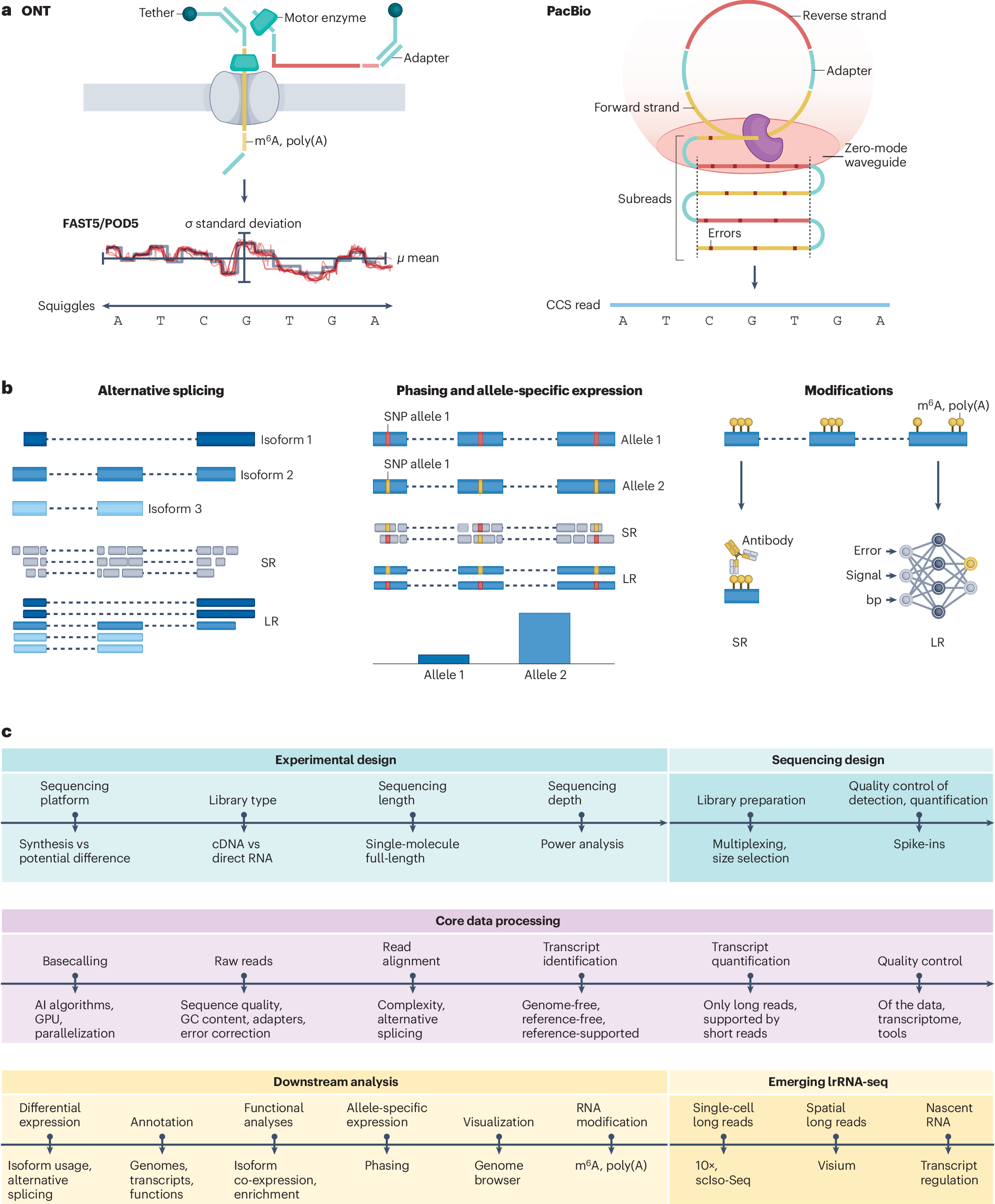
a, In long-read sequencing using Oxford Nanopore Technologies (ONT), cDNA or RNA molecules (in red and yellow) are tagged with sequencing adapters (in light blue) preloaded with a motor protein, and combined with a tether that localizes the molecules close to the flow cell. The sequencing occurs by introducing the sequencing adapter into a nanoscale pore and the motor protein unwinding the double-stranded molecules to drive them through the nanopore. As the molecule passes through the pore, the disruptions on the electric signal crossing the pore (squiggles) are measured and recorded in FAST5 or POD5 formatted files. Changes in current within the pore are used to identify the molecule sequences. In long-read single-molecule, real-time sequencing (SMRT) using Pacific Biosciences (PacBio), cDNA molecules (forward strand in yellow and reverse strand in red) are ligated to hairpin adapters (in light blue) to form circular molecules known as SMRTbells. SMRTbells are bound to polymerases (in purple) and immobilized in zero-mode waveguides. The polymerase synthesizes a new strand of cDNA using fluorescently labelled deoxynucleoside triphosphates (dNTPs) that are excited by light pulses. The fluorescent wavelengths are recorded, and the fluorophores are cleaved from the nucleotides to prevent fluorescent interference during the subsequent dNTP incorporation and light pulse. Multiple sequencing passes of the circularized cDNA molecule (subreads) allow for the generation of a consensus sequence of high accuracy. b, Core applications of long-read sequencing. Unlike short-read sequencing, long-read sequencing can capture full-length transcript isoforms in a single read, preserving exon continuity and identifying phased polymorphisms, which allows for allele differentiation and expression quantification and resolves the expression of highly similar transcripts. Additionally, although short-read sequencing of RNA modifications could only be performed indirectly by using RNA modification-specific antibodies to enrich fragments, or using chemical treatments to alter nucleotide bases, ONT directly detects epitranscriptomic modifications in the RNA molecule using unsupervised, supervised or semisupervised methods to identify specific disruption signatures in the electric current. c, The long-read RNA sequencing (lrRNA-seq) workflow: adequate experimental and sequencing design is necessary to obtain a data set that effectively addresses the biological questions of interest. The key steps for experimental and sequencing design, core data processing, downstream analysis and emerging applications are listed above the lines. The key considerations of each step are listed below the lines. Key factors include RNA quality, technology selection, library preparation methods, sequencing depth and the use of multiplexing and internal controls. Core data processing involves steps for transcriptome profiling and quality control. Downstream analyses encompass genome annotation, differential gene expression and functional interpretation. Emerging lrRNA-seq applications are expanding long-read sequencing to single-cell resolution and enabling the exploration of other aspects of RNA biology. AI, artificial intelligence; bp, base pairs; CCS, circular consensus sequencing; GC, guanosine–cytosine; GPU, graphical processing unit; LR, long read; poly(A), polyadenylation; scIso-Seq, single-cell RNA isoform sequencing; SNP, single nucleotide polymorphism; SR, short read.
By embracing these advancements, scientists can gain a more comprehensive understanding of gene expression, paving the way for breakthroughs in genetics, disease research, and personalized medicine.
Monzó C, Liu T, Conesa A. (2025) Transcriptomics in the era of long-read sequencing. Nat Rev Genet [Epub ahead of print]. [article]
Related Posts


RNA sequencing (RNA-seq) has transformed how scientists study gene expression, revealing new insights into how genes are turned on and off in different conditions. Traditionally, short-read sequencing has been the gold standard, helping researchers detect and quantify genes with great precision. However, short reads struggle to capture the full picture, particularly when it comes to understanding complex gene structures like alternative splicing, novel isoforms, and fusion transcripts.
Researchers at the Spanish National Research Council explore how long-read sequencing is addressing these limitations. Over the past five years, advances in technology and data analysis have made long-read RNA-seq more accessible and powerful, enabling researchers to sequence full-length transcripts with greater accuracy.
The researchers provide a step-by-step guide for researchers new to long-read RNA sequencing, covering everything from sample preparation and sequencing challenges to data analysis and future developments. As benchmarking studies continue to evaluate the strengths and weaknesses of this approach, the field is moving closer to making long-read RNA-seq a routine tool for transcriptomic research.
Overview of long-read transcriptomics, applications and computational analyses
a, In long-read sequencing using Oxford Nanopore Technologies (ONT), cDNA or RNA molecules (in red and yellow) are tagged with sequencing adapters (in light blue) preloaded with a motor protein, and combined with a tether that localizes the molecules close to the flow cell. The sequencing occurs by introducing the sequencing adapter into a nanoscale pore and the motor protein unwinding the double-stranded molecules to drive them through the nanopore. As the molecule passes through the pore, the disruptions on the electric signal crossing the pore (squiggles) are measured and recorded in FAST5 or POD5 formatted files. Changes in current within the pore are used to identify the molecule sequences. In long-read single-molecule, real-time sequencing (SMRT) using Pacific Biosciences (PacBio), cDNA molecules (forward strand in yellow and reverse strand in red) are ligated to hairpin adapters (in light blue) to form circular molecules known as SMRTbells. SMRTbells are bound to polymerases (in purple) and immobilized in zero-mode waveguides. The polymerase synthesizes a new strand of cDNA using fluorescently labelled deoxynucleoside triphosphates (dNTPs) that are excited by light pulses. The fluorescent wavelengths are recorded, and the fluorophores are cleaved from the nucleotides to prevent fluorescent interference during the subsequent dNTP incorporation and light pulse. Multiple sequencing passes of the circularized cDNA molecule (subreads) allow for the generation of a consensus sequence of high accuracy. b, Core applications of long-read sequencing. Unlike short-read sequencing, long-read sequencing can capture full-length transcript isoforms in a single read, preserving exon continuity and identifying phased polymorphisms, which allows for allele differentiation and expression quantification and resolves the expression of highly similar transcripts. Additionally, although short-read sequencing of RNA modifications could only be performed indirectly by using RNA modification-specific antibodies to enrich fragments, or using chemical treatments to alter nucleotide bases, ONT directly detects epitranscriptomic modifications in the RNA molecule using unsupervised, supervised or semisupervised methods to identify specific disruption signatures in the electric current. c, The long-read RNA sequencing (lrRNA-seq) workflow: adequate experimental and sequencing design is necessary to obtain a data set that effectively addresses the biological questions of interest. The key steps for experimental and sequencing design, core data processing, downstream analysis and emerging applications are listed above the lines. The key considerations of each step are listed below the lines. Key factors include RNA quality, technology selection, library preparation methods, sequencing depth and the use of multiplexing and internal controls. Core data processing involves steps for transcriptome profiling and quality control. Downstream analyses encompass genome annotation, differential gene expression and functional interpretation. Emerging lrRNA-seq applications are expanding long-read sequencing to single-cell resolution and enabling the exploration of other aspects of RNA biology. AI, artificial intelligence; bp, base pairs; CCS, circular consensus sequencing; GC, guanosine–cytosine; GPU, graphical processing unit; LR, long read; poly(A), polyadenylation; scIso-Seq, single-cell RNA isoform sequencing; SNP, single nucleotide polymorphism; SR, short read.
By embracing these advancements, scientists can gain a more comprehensive understanding of gene expression, paving the way for breakthroughs in genetics, disease research, and personalized medicine.
Monzó C, Liu T, Conesa A. (2025) Transcriptomics in the era of long-read sequencing. Nat Rev Genet [Epub ahead of print]. [article]
Related Posts
Recent Posts
 Machine learning reveals how RNA splicing is regulated in individual cell types
 Illumina releases SpliceAI2 to help advance rare disease research
 Postdoctoral Fellow – Long-Read RNA Methods Development for Neurodegeneration
 Novel biosensor uses DNA ‘barcodes’ to uncover disease signals in cells
 GP-DHT uses single-cell RNA sequencing to map gene regulatory networks
 Boehringer taps Envisagenics’ AI to mine RNA splicing for cancer targets
RNA-Seq Products & Services



Stay Connected