

Understanding RNA modifications is essential for learning how cells control which genes turn on and off. Until recently, however, scientists needed large amounts of RNA to study these chemical changes. This made it difficult to analyze rare cell types or very small samples.
A team led by at the Fudan University Shanghai Cancer Center has now developed a technique called Uli-epic, which makes this process far more accessible. This method allows researchers to detect and measure chemical changes on RNA even when only tiny amounts are available. Instead of requiring harsh chemical treatments and large quantities of RNA, Uli-epic works with extremely small inputs, including as little as 100 picograms. For context, that is far less than what can be seen with the naked eye.
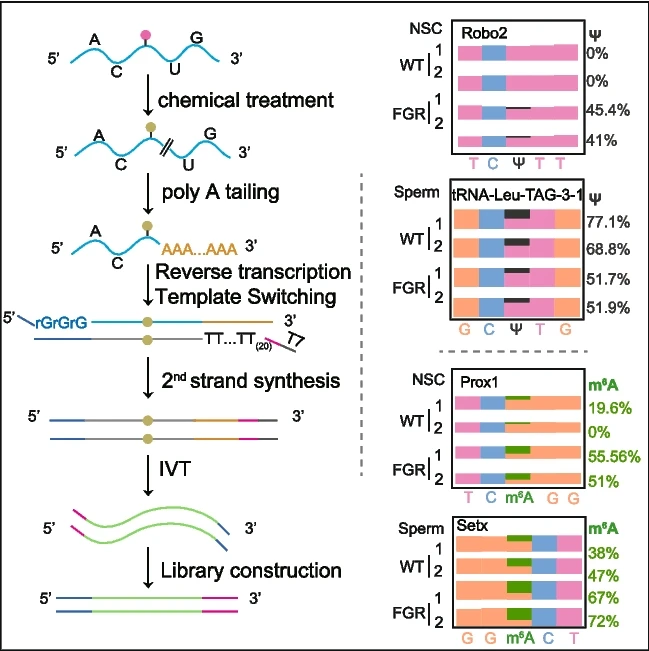
The researchers created two versions of the technology. Uli-epic BID-seq helps identify where pseudouridine appears on RNA. Using this approach, the team studied neural stem cells and sperm from both normal mice and those experiencing fetal growth restriction, needing only 500 picograms of RNA for each analysis.
They also developed Uli-epic GLORI, a method that measures another important RNA modification called m6A. With this approach, they analyzed sperm and neural stem cells from both healthy and growth-restricted mice using just 10 nanograms of RNA.
These advances open the door for studying RNA chemistry in rare cell types, early developmental stages, and precious clinical samples. Because Uli-epic can work with such small amounts of material, it makes epitranscriptomic research more accessible and reliable, helping scientists better understand how RNA modifications shape health and development.
He W, He W, Xu C, Chen W, Jiang X, Wang Y, Peng Y, Chang S, Zhu W, Kang J, Hu L. (2025) Uli-epic, profiling RNA modifications from ultra low input samples. Genome Biology 26(1): 384. [article]
Related Posts




Understanding RNA modifications is essential for learning how cells control which genes turn on and off. Until recently, however, scientists needed large amounts of RNA to study these chemical changes. This made it difficult to analyze rare cell types or very small samples.
A team led by at the Fudan University Shanghai Cancer Center has now developed a technique called Uli-epic, which makes this process far more accessible. This method allows researchers to detect and measure chemical changes on RNA even when only tiny amounts are available. Instead of requiring harsh chemical treatments and large quantities of RNA, Uli-epic works with extremely small inputs, including as little as 100 picograms. For context, that is far less than what can be seen with the naked eye.
The researchers created two versions of the technology. Uli-epic BID-seq helps identify where pseudouridine appears on RNA. Using this approach, the team studied neural stem cells and sperm from both normal mice and those experiencing fetal growth restriction, needing only 500 picograms of RNA for each analysis.
They also developed Uli-epic GLORI, a method that measures another important RNA modification called m6A. With this approach, they analyzed sperm and neural stem cells from both healthy and growth-restricted mice using just 10 nanograms of RNA.
These advances open the door for studying RNA chemistry in rare cell types, early developmental stages, and precious clinical samples. Because Uli-epic can work with such small amounts of material, it makes epitranscriptomic research more accessible and reliable, helping scientists better understand how RNA modifications shape health and development.
He W, He W, Xu C, Chen W, Jiang X, Wang Y, Peng Y, Chang S, Zhu W, Kang J, Hu L. (2025) Uli-epic, profiling RNA modifications from ultra low input samples. Genome Biology 26(1): 384. [article]
Related Posts
Recent Posts
 RNAmel simplifies RNA sequencing data analysis with a reproducible, integrated platform
 Heart failure reshapes bone marrow to create inflammation-related immune memory
 Overlooked DNA regions surrounding ‘microexons’ hold missing pieces of autism’s genetic puzzle
 RiboBA improves detection of hidden protein-coding regions using ribosome profiling
 An anti-senescence gene may fight spinal disc deterioration
 Bulk RNA-seq Analysis: A Complete Beginner’s Guide
RNA-Seq Products & Services



Stay Connected