

Researchers are constantly developing new tools to understand how our genes are regulated. One such tool is single-cell ATAC-seq, short for Assay for Transposase Accessible Chromatin with Sequencing, which helps identify which regions of DNA are open and active in individual cells. This is important because open chromatin regions often indicate where genes can be turned on or off, providing insight into how cells function.
Researchers at St Vincent’s Institute of Medical Research have investigated the challenges of analyzing this type of data. Unlike RNA sequencing, which captures gene activity more directly, ATAC-seq data is extremely sparse, meaning there are many gaps in the information collected from each cell. This makes it difficult to draw firm conclusions about which parts of the genome are truly accessible in single cells.
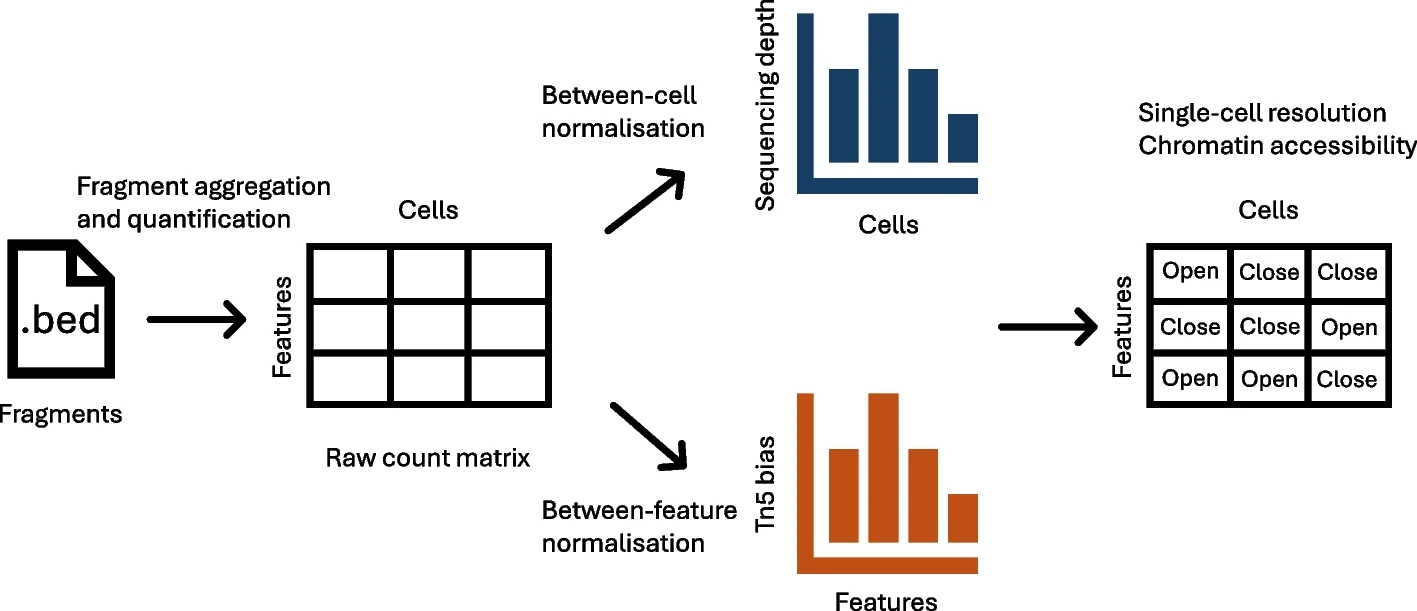
Conceptual diagram for key challenges in typical scATAC-seq data analysis, including fragment aggregation and quantification, between-cell normalization, between-feature normalization, and interpreting chromatin accessibility at single-cell resolution
The team introduced a hierarchical count-based model to better reflect the process by which ATAC-seq data is generated. Their simulations showed that while scATAC-seq clearly captures data at the single-cell level, it cannot yet reliably resolve chromatin accessibility at the level of individual DNA regions in single cells.
This research highlights both the power and the current limits of scATAC-seq technology. While it is highly valuable for identifying broad patterns across cell types, it may not yet provide the fine-grained details researchers often hope for. The authors suggest that improvements in assay efficiency could eventually allow scientists to reach true single-cell, single-region resolution in chromatin studies.
Cheung AW, Shim H, McCarthy DJ. (2025) A hierarchical, count-based model highlights challenges in scATAC-seq data analysis and points to opportunities to extract finer-resolution information. Genome Biol 26(1): 282. [article]
Related Posts




Researchers are constantly developing new tools to understand how our genes are regulated. One such tool is single-cell ATAC-seq, short for Assay for Transposase Accessible Chromatin with Sequencing, which helps identify which regions of DNA are open and active in individual cells. This is important because open chromatin regions often indicate where genes can be turned on or off, providing insight into how cells function.
Researchers at St Vincent’s Institute of Medical Research have investigated the challenges of analyzing this type of data. Unlike RNA sequencing, which captures gene activity more directly, ATAC-seq data is extremely sparse, meaning there are many gaps in the information collected from each cell. This makes it difficult to draw firm conclusions about which parts of the genome are truly accessible in single cells.
Conceptual diagram for key challenges in typical scATAC-seq data analysis, including fragment aggregation and quantification, between-cell normalization, between-feature normalization, and interpreting chromatin accessibility at single-cell resolution
The team introduced a hierarchical count-based model to better reflect the process by which ATAC-seq data is generated. Their simulations showed that while scATAC-seq clearly captures data at the single-cell level, it cannot yet reliably resolve chromatin accessibility at the level of individual DNA regions in single cells.
This research highlights both the power and the current limits of scATAC-seq technology. While it is highly valuable for identifying broad patterns across cell types, it may not yet provide the fine-grained details researchers often hope for. The authors suggest that improvements in assay efficiency could eventually allow scientists to reach true single-cell, single-region resolution in chromatin studies.
Cheung AW, Shim H, McCarthy DJ. (2025) A hierarchical, count-based model highlights challenges in scATAC-seq data analysis and points to opportunities to extract finer-resolution information. Genome Biol 26(1): 282. [article]
Related Posts
Recent Posts
 Scientists identify the neuroblastoma cells that signal poor outcomes
 GARAGE improves rare cell detection in single-cell RNA sequencing analysis using AI
 Machine learning reveals how RNA splicing is regulated in individual cell types
 Illumina releases SpliceAI2 to help advance rare disease research
 Postdoctoral Fellow – Long-Read RNA Methods Development for Neurodegeneration
 Novel biosensor uses DNA ‘barcodes’ to uncover disease signals in cells
RNA-Seq Products & Services



Stay Connected