

Researchers at the Université du Québec À Montréal have uncovered new insights into the regulatory elements of the rice genome by integrating multiple genomic approaches. In juvenile leaf tissues of the Azucena rice variety, the team combined analyses of conserved noncoding sequences, intergenic bi-directional nascent transcripts, and chromatin accessibility to identify regions that control gene activity.
The study revealed distinct classes of regulatory elements, some of which are linked to complex gene interactions, while others promote more stable gene expression. Interestingly, certain transcribed regulatory sites also appear to silence transposable elements, while others boost expression of nearby genes. By analyzing 3-dimensional chromatin contacts, the researchers observed physical interactions between transcribed intergenic regions and genic regions, which often coincided with increased gene transcription, further supporting a regulatory role.
Schematic overview of the main findings of this study
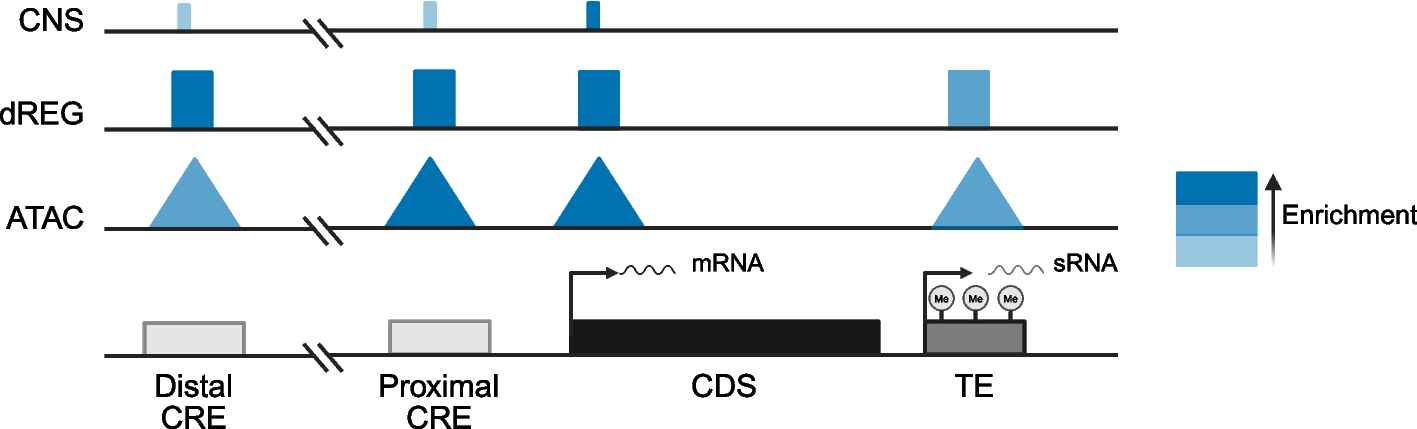
It is focusing on three classes of genomic elements: CNS (conserved noncoding sequences), dREG (regulatory regions identified by dREG), and ATAC (ATAC-seq peaks). Genomic features are depicted as rectangles: light gray for cis-regulatory elements (CREs), black for coding sequences (CDSs), and dark gray for transposable elements (TEs). Small RNAs (sRNAs) and messenger RNAs (mRNAs) are indicated, and DNA methylation on TEs is shown as gray circles labeled “Me.” The width of each peak reflects the median length (in nucleotides) of the corresponding feature, and color intensity qualitatively represents signal strength
This integrative approach highlights the importance of using multiple genomic signals to discover and characterize the diverse mechanisms plants use to regulate gene expression. These findings could help scientists better understand crop biology and improve strategies for plant breeding and genetic engineering.
Goliasse M, Johary A, Platts AE, Ortner-Krause F, Edger PP, Choi JY, Purugganan MD, Joly-Lopez Z. (2025) Uncovering the multi-layer cis-regulatory landscape of rice via integrative nascent RNA analysis. Genome Biology 26(1): 250. [article]
Related Posts






Researchers at the Université du Québec À Montréal have uncovered new insights into the regulatory elements of the rice genome by integrating multiple genomic approaches. In juvenile leaf tissues of the Azucena rice variety, the team combined analyses of conserved noncoding sequences, intergenic bi-directional nascent transcripts, and chromatin accessibility to identify regions that control gene activity.
The study revealed distinct classes of regulatory elements, some of which are linked to complex gene interactions, while others promote more stable gene expression. Interestingly, certain transcribed regulatory sites also appear to silence transposable elements, while others boost expression of nearby genes. By analyzing 3-dimensional chromatin contacts, the researchers observed physical interactions between transcribed intergenic regions and genic regions, which often coincided with increased gene transcription, further supporting a regulatory role.
Schematic overview of the main findings of this study
It is focusing on three classes of genomic elements: CNS (conserved noncoding sequences), dREG (regulatory regions identified by dREG), and ATAC (ATAC-seq peaks). Genomic features are depicted as rectangles: light gray for cis-regulatory elements (CREs), black for coding sequences (CDSs), and dark gray for transposable elements (TEs). Small RNAs (sRNAs) and messenger RNAs (mRNAs) are indicated, and DNA methylation on TEs is shown as gray circles labeled “Me.” The width of each peak reflects the median length (in nucleotides) of the corresponding feature, and color intensity qualitatively represents signal strength
This integrative approach highlights the importance of using multiple genomic signals to discover and characterize the diverse mechanisms plants use to regulate gene expression. These findings could help scientists better understand crop biology and improve strategies for plant breeding and genetic engineering.
Goliasse M, Johary A, Platts AE, Ortner-Krause F, Edger PP, Choi JY, Purugganan MD, Joly-Lopez Z. (2025) Uncovering the multi-layer cis-regulatory landscape of rice via integrative nascent RNA analysis. Genome Biology 26(1): 250. [article]
Related Posts
Recent Posts
 RNAmel simplifies RNA sequencing data analysis with a reproducible, integrated platform
 Heart failure reshapes bone marrow to create inflammation-related immune memory
 Overlooked DNA regions surrounding ‘microexons’ hold missing pieces of autism’s genetic puzzle
 RiboBA improves detection of hidden protein-coding regions using ribosome profiling
 An anti-senescence gene may fight spinal disc deterioration
 Bulk RNA-seq Analysis: A Complete Beginner’s Guide
RNA-Seq Products & Services


Stay Connected