

Researchers from Lund University compared two powerful RNA sequencing methods, single-cell (scRNA-seq) and single-nuclei (snRNA-seq), to understand how human pancreatic islet cells express their genes. These cells, which include insulin-producing beta cells, are key to understanding diabetes and metabolic health.
Study design and donor characteristics
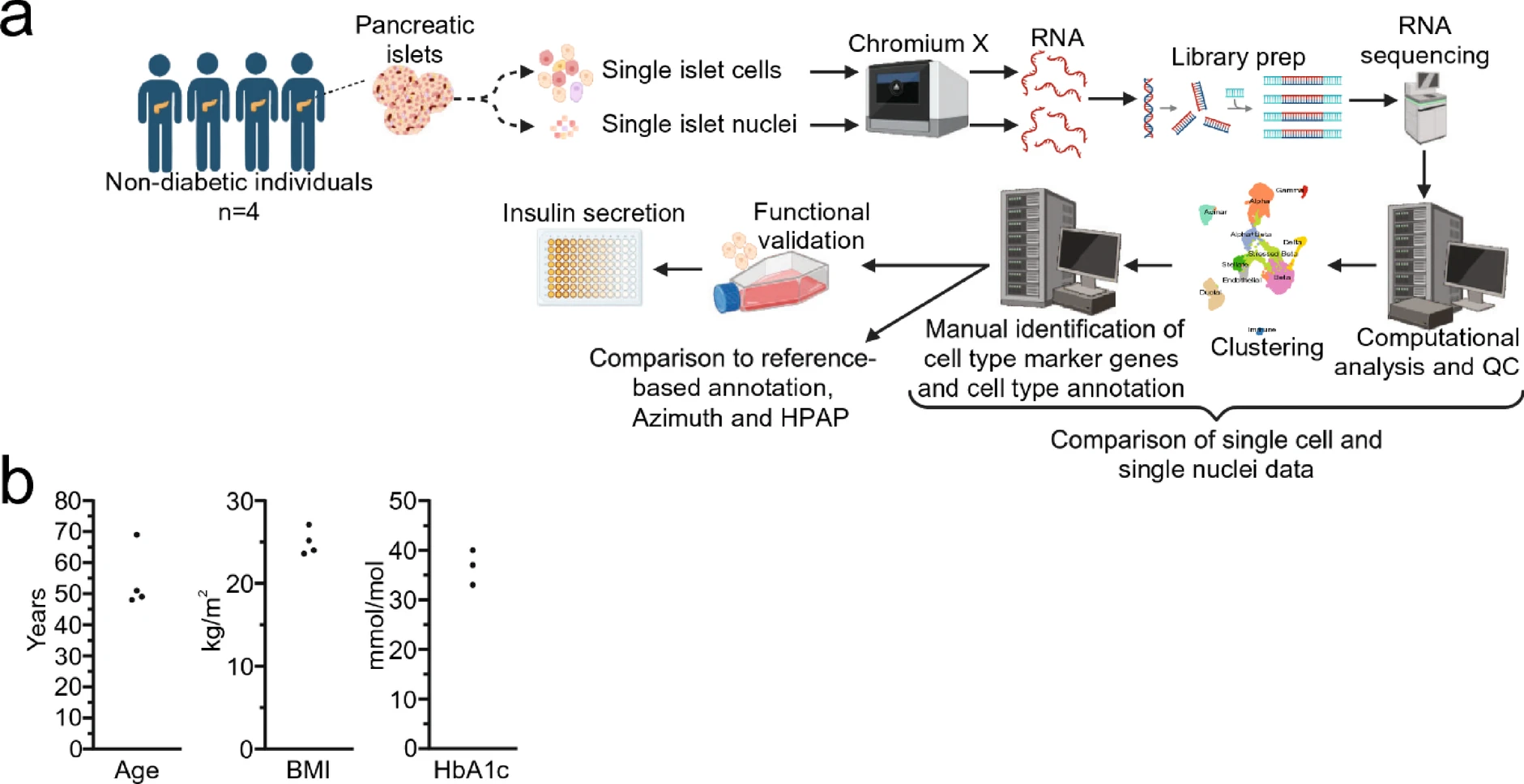
(a) A schematic picture of the study design, including four non-diabetic donors, while (b) shows donor characteristics for age, body mass index (BMI), and HbA1c (a measure of average blood glucose levels over the past months, used to diagnose prediabetes and diabetes, one missing value).
While both methods analyze gene expression at the level of individual cells, only snRNA-seq can be used on frozen biobanked samples, which are often the only available tissue sources. However, most existing reference datasets were built from scRNA-seq data, raising concerns about how well they apply to snRNA-seq results.
The team analyzed samples from four human donors and compared how different annotation methods categorized cell types and detected genes. Both techniques identified similar cell types, but the proportions of those cells differed depending on the sequencing method and annotation approach. Reference-based methods were more accurate for scRNA-seq, while snRNA-seq required more careful interpretation.
Importantly, the researchers identified several new marker genes specific to snRNA-seq data, including DOCK10 and KIRREL3 for beta cells, STK32B for alpha cells, and LAMC2 for ductal cells. They also confirmed ZNF385D as a beta cell marker whose silencing reduced insulin secretion, reinforcing its role in islet biology.
This research underscores the importance of developing tailored annotation strategies for snRNA-seq data to ensure accurate cell type identification and improve our understanding of complex tissues like the pancreas.
Engström K, Nilsson Å, Ofori JK, Wierup N, Bacos K, Ling C. (2025) Evaluating cell-specific gene expression using single-cell and single-nuclei RNA-sequencing data from human pancreatic islets of the same donors. Scientific Reports 15(1):36133. [article]
Related Posts




Researchers from Lund University compared two powerful RNA sequencing methods, single-cell (scRNA-seq) and single-nuclei (snRNA-seq), to understand how human pancreatic islet cells express their genes. These cells, which include insulin-producing beta cells, are key to understanding diabetes and metabolic health.
Study design and donor characteristics
(a) A schematic picture of the study design, including four non-diabetic donors, while (b) shows donor characteristics for age, body mass index (BMI), and HbA1c (a measure of average blood glucose levels over the past months, used to diagnose prediabetes and diabetes, one missing value).
While both methods analyze gene expression at the level of individual cells, only snRNA-seq can be used on frozen biobanked samples, which are often the only available tissue sources. However, most existing reference datasets were built from scRNA-seq data, raising concerns about how well they apply to snRNA-seq results.
The team analyzed samples from four human donors and compared how different annotation methods categorized cell types and detected genes. Both techniques identified similar cell types, but the proportions of those cells differed depending on the sequencing method and annotation approach. Reference-based methods were more accurate for scRNA-seq, while snRNA-seq required more careful interpretation.
Importantly, the researchers identified several new marker genes specific to snRNA-seq data, including DOCK10 and KIRREL3 for beta cells, STK32B for alpha cells, and LAMC2 for ductal cells. They also confirmed ZNF385D as a beta cell marker whose silencing reduced insulin secretion, reinforcing its role in islet biology.
This research underscores the importance of developing tailored annotation strategies for snRNA-seq data to ensure accurate cell type identification and improve our understanding of complex tissues like the pancreas.
Engström K, Nilsson Å, Ofori JK, Wierup N, Bacos K, Ling C. (2025) Evaluating cell-specific gene expression using single-cell and single-nuclei RNA-sequencing data from human pancreatic islets of the same donors. Scientific Reports 15(1):36133. [article]
Related Posts
Recent Posts
 Scientists identify the neuroblastoma cells that signal poor outcomes
 GARAGE improves rare cell detection in single-cell RNA sequencing analysis using AI
 Machine learning reveals how RNA splicing is regulated in individual cell types
 Illumina releases SpliceAI2 to help advance rare disease research
 Postdoctoral Fellow – Long-Read RNA Methods Development for Neurodegeneration
 Novel biosensor uses DNA ‘barcodes’ to uncover disease signals in cells
RNA-Seq Products & Services


Stay Connected