

Researchers at the Vellore Institute of Technology have explored an exciting intersection between artificial intelligence and biology, where language models originally developed for text, like ChatGPT, are now being used to interpret DNA. These new systems, called Genome Large Language Models (Gene-LLMs), are trained to read and understand the genetic code in much the same way that natural language models learn to read and understand human language.
Instead of sentences and words, Gene-LLMs process raw DNA sequences and gene expression data, identifying the “grammar” and “syntax” that govern biological functions. By doing so, they can uncover how genes are regulated, how proteins interact with RNA, and even how changes in DNA can affect health and disease.
The researchers describe how these models are trained through a process called self-supervised pretraining, where the model learns patterns from vast genomic datasets without explicit human labeling. Just as a language model might predict missing words in a sentence, Gene-LLMs can predict missing nucleotides or relationships between sequences. This allows them to learn intricate genomic patterns that might otherwise remain hidden.
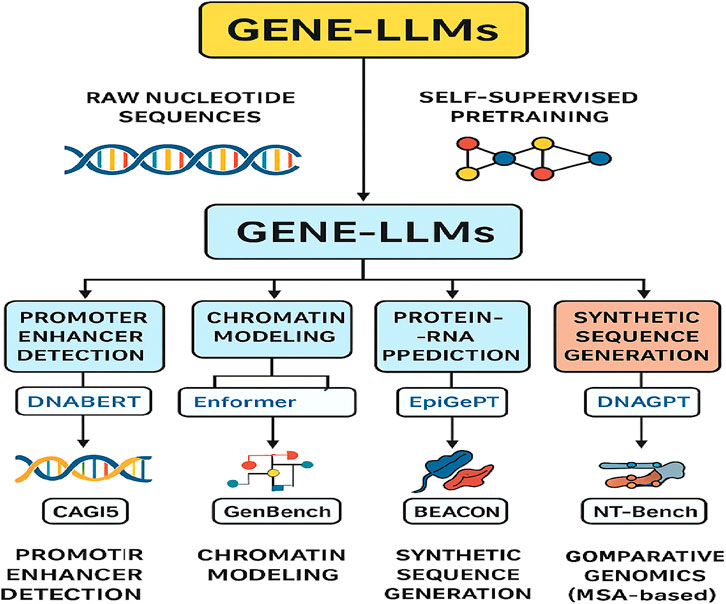
Workflow of Gene-LLMs from raw nucleotide sequences to self-supervised pretraining, enabling key genomic tasks with example models and benchmarks.
Gene-LLMs are already being applied to several key areas of genomics, including identifying enhancers and promoters (regions that regulate gene activity), predicting RNA–protein interactions, and modeling the three-dimensional structure of chromatin. Beyond research, they have the potential to assist in clinical diagnostics by helping identify disease-associated mutations and in evolutionary studies by tracing genetic patterns across species.
The researchers also discuss how the models are evolving through improved architectures, such as encoder, decoder frameworks and positional embeddings that account for the unique spatial organization of genetic material. These enhancements may increase interpretability and open doors for real-world applications in personalized medicine and rare variant discovery.
Looking forward, the authors highlight several frontiers for Gene-LLMs, including federated learning that allows multiple research centers to collaborate securely on sensitive genetic data, multimodal models that integrate different types of biological data, and approaches for studying rare conditions with limited available data. With continued development, Gene-LLMs could become a cornerstone of the next generation of bioinformatics, bridging AI and biology in ways that deepen our understanding of life itself.
Balakrishnan P, Anny Leema A, Dhivya Shree V, Mohammad Saad C, Mohan Babu A. (2025) Gene-LLMs: a comprehensive survey of transformer-based genomic language models for regulatory and clinical genomics. Frontiers in Genetics 16(2025): Article 1634882. [article]
Related Posts


Researchers at the Vellore Institute of Technology have explored an exciting intersection between artificial intelligence and biology, where language models originally developed for text, like ChatGPT, are now being used to interpret DNA. These new systems, called Genome Large Language Models (Gene-LLMs), are trained to read and understand the genetic code in much the same way that natural language models learn to read and understand human language.
Instead of sentences and words, Gene-LLMs process raw DNA sequences and gene expression data, identifying the “grammar” and “syntax” that govern biological functions. By doing so, they can uncover how genes are regulated, how proteins interact with RNA, and even how changes in DNA can affect health and disease.
The researchers describe how these models are trained through a process called self-supervised pretraining, where the model learns patterns from vast genomic datasets without explicit human labeling. Just as a language model might predict missing words in a sentence, Gene-LLMs can predict missing nucleotides or relationships between sequences. This allows them to learn intricate genomic patterns that might otherwise remain hidden.
Workflow of Gene-LLMs from raw nucleotide sequences to self-supervised pretraining, enabling key genomic tasks with example models and benchmarks.
Gene-LLMs are already being applied to several key areas of genomics, including identifying enhancers and promoters (regions that regulate gene activity), predicting RNA–protein interactions, and modeling the three-dimensional structure of chromatin. Beyond research, they have the potential to assist in clinical diagnostics by helping identify disease-associated mutations and in evolutionary studies by tracing genetic patterns across species.
The researchers also discuss how the models are evolving through improved architectures, such as encoder, decoder frameworks and positional embeddings that account for the unique spatial organization of genetic material. These enhancements may increase interpretability and open doors for real-world applications in personalized medicine and rare variant discovery.
Looking forward, the authors highlight several frontiers for Gene-LLMs, including federated learning that allows multiple research centers to collaborate securely on sensitive genetic data, multimodal models that integrate different types of biological data, and approaches for studying rare conditions with limited available data. With continued development, Gene-LLMs could become a cornerstone of the next generation of bioinformatics, bridging AI and biology in ways that deepen our understanding of life itself.
Balakrishnan P, Anny Leema A, Dhivya Shree V, Mohammad Saad C, Mohan Babu A. (2025) Gene-LLMs: a comprehensive survey of transformer-based genomic language models for regulatory and clinical genomics. Frontiers in Genetics 16(2025): Article 1634882. [article]
Related Posts
Recent Posts
 RNAmel simplifies RNA sequencing data analysis with a reproducible, integrated platform
 Heart failure reshapes bone marrow to create inflammation-related immune memory
 Overlooked DNA regions surrounding ‘microexons’ hold missing pieces of autism’s genetic puzzle
 RiboBA improves detection of hidden protein-coding regions using ribosome profiling
 An anti-senescence gene may fight spinal disc deterioration
 Bulk RNA-seq Analysis: A Complete Beginner’s Guide
RNA-Seq Products & Services



Stay Connected