Purple tea, known for its vivid color and health benefits, is gaining global attention, but the genetic mechanism behind its purple leaves remained unclear. This study combined bulked segregant analysis (BSA-seq), bulked segregant RNA sequencing (BSR-seq), and transcriptome analysis (RNA-seq) on a segregating F1 tea population to uncover the molecular basis of anthocyanin accumulation. Researchers identified two key genes, CsMYB75 and CsANS, that drive purple leaf formation through enhanced gene expression and specific genetic variations. The silencing of CsMYB75 confirmed its essential regulatory role. A 181-bp InDel in the promoter of CsMYB75 was also discovered, providing a reliable genetic marker for purple leaf traits in breeding.
Purple tea (Camellia sinensis) contains high levels of anthocyanins, a class of flavonoids with antioxidant, anti-inflammatory, and anti-obesity properties. These pigments are not only important for tea quality but also for their therapeutic potential in preventing metabolic and neurodegenerative disorders. While previous studies identified individual genes linked to purple traits in isolated cultivars, the regulatory network and genetic variations responsible for color development across diverse populations remain poorly understood. The complex genetics of tea plants and the lack of reliable markers hinder efficient breeding of purple tea cultivars. Due to these challenges, there is a pressing need to deeply investigate the molecular regulation of anthocyanin biosynthesis in genetically diverse tea populations.
Researchers from the Tea Research Institute at the Chinese Academy of Agricultural Sciences have published new findings in Horticulture Research, unveiling the genetic drivers of purple leaf formation in tea plants. By integrating BSA-seq, BSR-seq, and RNA-seq in an F1 population from ‘Zijuan’ and ‘Jinxuan’ cultivars, the team identified core genes controlling anthocyanin accumulation. The study highlights CsMYB75 and CsANS as major contributors to leaf pigmentation and reveals a novel InDel mutation that serves as a reliable marker for purple coloration in tea.
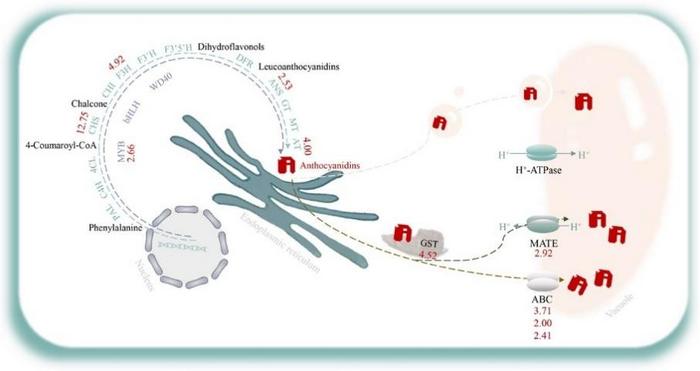
Schematic diagram of anthocyanin biosynthesis and transport in a purple population of tea plants. The numerical markers represent the expression of the gene in the purple sample, with the green sample as the control.
The team studied 30 tea plants with extreme leaf colors, either dark purple or green, selected from a cross between purple-leaf ‘Zijuan’ and green-leaf ‘Jinxuan’. Using high-throughput RNA-seq, 459 differentially expressed genes (DEGs) were identified, with CHS, F3H, ANS, GST, MATE, and ABCC among those highly expressed in purple leaves. BSA-seq and BSR-seq further narrowed down critical genomic regions associated with pigmentation on chromosomes 2 and 14. Integrative analysis pinpointed two key genes, CsMYB75 (a transcription factor) and CsANS (anthocyanidin synthase), both showing sequence variation and elevated expression in purple samples. Functional validation using antisense oligonucleotide-mediated gene silencing of CsMYB75 in purple tea confirmed its regulatory effect on downstream structural genes like ANS and F3H. Moreover, a 181-bp insertion in the promoter of CsMYB75 was found to co-segregate with purple leaf phenotype, enhancing gene expression. This insertion contains MYB recognition elements, suggesting a self-activation mechanism. These findings not only validate CsMYB75’s role in anthocyanin biosynthesis but also offer a new molecular marker for breeding.
“Our study provides the first direct evidence of how CsMYB75 and CsANS coordinate to regulate purple coloration in tea leaves,” said Dr. Liang Chen, senior author of the study. “The identification of the 181-bp promoter InDel is especially exciting, as it offers a simple genetic marker for selecting anthocyanin-rich cultivars. This integrated approach demonstrates how combining transcriptomics with genomic analysis can accelerate functional discovery in perennial crops like tea.”
The discovery of key pigmentation genes and regulatory elements in purple tea opens up new opportunities for targeted breeding of high-anthocyanin tea cultivars. The 181-bp InDel in the CsMYB75 promoter can serve as a practical marker for breeders to screen and select desirable traits. Beyond aesthetics, enhancing anthocyanin content in tea can improve its antioxidant capacity, offering health-promoting benefits to consumers. This research not only advances our understanding of tea plant genetics but also contributes to the sustainable development of functional beverages with elevated nutraceutical value.


Purple tea, known for its vivid color and health benefits, is gaining global attention, but the genetic mechanism behind its purple leaves remained unclear. This study combined bulked segregant analysis (BSA-seq), bulked segregant RNA sequencing (BSR-seq), and transcriptome analysis (RNA-seq) on a segregating F1 tea population to uncover the molecular basis of anthocyanin accumulation. Researchers identified two key genes, CsMYB75 and CsANS, that drive purple leaf formation through enhanced gene expression and specific genetic variations. The silencing of CsMYB75 confirmed its essential regulatory role. A 181-bp InDel in the promoter of CsMYB75 was also discovered, providing a reliable genetic marker for purple leaf traits in breeding.
Purple tea (Camellia sinensis) contains high levels of anthocyanins, a class of flavonoids with antioxidant, anti-inflammatory, and anti-obesity properties. These pigments are not only important for tea quality but also for their therapeutic potential in preventing metabolic and neurodegenerative disorders. While previous studies identified individual genes linked to purple traits in isolated cultivars, the regulatory network and genetic variations responsible for color development across diverse populations remain poorly understood. The complex genetics of tea plants and the lack of reliable markers hinder efficient breeding of purple tea cultivars. Due to these challenges, there is a pressing need to deeply investigate the molecular regulation of anthocyanin biosynthesis in genetically diverse tea populations.
Researchers from the Tea Research Institute at the Chinese Academy of Agricultural Sciences have published new findings in Horticulture Research, unveiling the genetic drivers of purple leaf formation in tea plants. By integrating BSA-seq, BSR-seq, and RNA-seq in an F1 population from ‘Zijuan’ and ‘Jinxuan’ cultivars, the team identified core genes controlling anthocyanin accumulation. The study highlights CsMYB75 and CsANS as major contributors to leaf pigmentation and reveals a novel InDel mutation that serves as a reliable marker for purple coloration in tea.
Schematic diagram of anthocyanin biosynthesis and transport in a purple population of tea plants. The numerical markers represent the expression of the gene in the purple sample, with the green sample as the control.
The team studied 30 tea plants with extreme leaf colors, either dark purple or green, selected from a cross between purple-leaf ‘Zijuan’ and green-leaf ‘Jinxuan’. Using high-throughput RNA-seq, 459 differentially expressed genes (DEGs) were identified, with CHS, F3H, ANS, GST, MATE, and ABCC among those highly expressed in purple leaves. BSA-seq and BSR-seq further narrowed down critical genomic regions associated with pigmentation on chromosomes 2 and 14. Integrative analysis pinpointed two key genes, CsMYB75 (a transcription factor) and CsANS (anthocyanidin synthase), both showing sequence variation and elevated expression in purple samples. Functional validation using antisense oligonucleotide-mediated gene silencing of CsMYB75 in purple tea confirmed its regulatory effect on downstream structural genes like ANS and F3H. Moreover, a 181-bp insertion in the promoter of CsMYB75 was found to co-segregate with purple leaf phenotype, enhancing gene expression. This insertion contains MYB recognition elements, suggesting a self-activation mechanism. These findings not only validate CsMYB75’s role in anthocyanin biosynthesis but also offer a new molecular marker for breeding.
The discovery of key pigmentation genes and regulatory elements in purple tea opens up new opportunities for targeted breeding of high-anthocyanin tea cultivars. The 181-bp InDel in the CsMYB75 promoter can serve as a practical marker for breeders to screen and select desirable traits. Beyond aesthetics, enhancing anthocyanin content in tea can improve its antioxidant capacity, offering health-promoting benefits to consumers. This research not only advances our understanding of tea plant genetics but also contributes to the sustainable development of functional beverages with elevated nutraceutical value.
Wang Y, Jin JQ, Zhang R, He M, Wang L, Mao Z, Gan M, Wu L, Chen L, Wang L, Wei K. (2024) Association analysis of BSA-seq, BSR-seq, and RNA-seq reveals key genes involved in purple leaf formation in a tea population (Camellia sinensis). Hortic Res 11(9): uhae191. [article]
Related Posts
Novel biosensor uses DNA ‘barcodes’ to uncover disease signals in cells
CellART extracts single-cell information from high-resolution spatial transcriptomics
Cell2space restores spatial context to single-cell RNA sequencing data
Urine test may improve bladder cancer diagnosis and guide treatment decisions
DeCoRE – a computational method to resolve RNA structural heterogeneity from RNA structure probing data by direct RNA sequencing
Tracing 700 million years of cell evolution
How should biological replicates be handled in long-read RNA sequencing?
RNA-Seq reveals a new way the developing heart controls its growth
The Human RNome Project Consortium seeks to publish first-ever complete sequence of the body’s RNA
scFlowReport brings multiple single-cell RNA sequencing analyses into one workflow
Long-read RNA sequencing reveals how neurons choose alternative RNA endings
DeOPUS improves cell-type estimates from bulk RNA sequencing
ResolVI improves accuracy in spatial transcriptomics analysis
RNA sequencing reveals transcriptional allele differences in prostate cancer stem cells
Unmasking “zombie cells” in aging tissue with an AI-powered barcode
RNA variant imaging for cancer diagnosis
Autism-risk mutations reveal two opposing patterns of brain gene activity
A real-data approach to evaluating RNA transcript analysis methods
Detection and sequencing of Ap2N-capped RNAs in human cells
Single-cell RNA sequencing provides a closer look at the Aedes aegypti midgut
Stay Connected
Submit a Post to the Blog
Recent Posts
Subscribe to the RNA-Seq Blog
RNA-Seq Products & Services