Researchers developed a urine test that detects bladder cancer, predicts which patients will benefit from immunotherapy versus chemotherapy, and can confirm whether treatment worked.
simple urine test devised by researchers at Stanford Medicine and the VA Palo Alto Health Care System can diagnose people with bladder cancer more accurately than current standard methods. The test also allows physicians to not only assess the cancer’s response to treatment but to predict whether immunotherapy or chemotherapy is likely to be most effective for each patient.
The test is unique in that it measures RNA messages shed by tumor cells into urine, rather than hunting for cancer-related mutations in DNA as most blood and urine liquid biopsies do. Because RNA reflects which genes a cancer cell is actively using, it captures a tumor’s behavior in addition to its presence.
“Measuring tumor DNA in urine can tell us whether a cancer is present,” said Maximilian Diehn, MD, PhD, the Jack, Lulu, and Sam Willson Professor and a professor of radiation oncology. “Analyzing RNA can tell us not only whether a cancer is present — but also what it’s doing.”
Diehn shares senior authorship of the study, which published Oct. 2 in Nature Medicine, with Joseph Liao, MD, the Kathryn Simmons Stamey Professor and chair of the department of urology, and Ash Alizadeh, MD, PhD, the Moghadam Family Professor. Graduate student Kevin J. Liu is the lead author of the research.
From blood to bladder
About 85,000 people in the United States are diagnosed each year with bladder cancer, which is prone to recurrence and expensive to monitor. Diagnosis and surveillance currently rely on cystoscopy, in which an endoscope is threaded into the bladder to look for suspicious tissue — a procedure that can miss up to 30% of cancer cases. High-risk patients with a history of non-muscle-invasive bladder cancer may need to undergo the surveillance procedure every three months.
After surgery to remove a tumor, many patients are treated with a weakened strain of the bacterium used in tuberculosis vaccines called Bacillus Calmette-Guérin, or BCG. BCG is instilled directly into the bladder through a catheter once a week for six weeks and may be repeated as maintenance for up to three years. BCG stimulates the patient’s immune system to destroy any lingering cancer cells. But the treatment doesn’t work for everyone — some tumors simply lack the underlying immune activity needed to spark an effective attack — and there’s been no reliable way to tell in advance who will benefit.
For more than a decade, Diehn and Alizadeh have collaborated on liquid biopsy technology, which involves testing blood and other types of fluids. In 2014, the pair developed CAPP-Seq (cancer personalized profiling by deep sequencing), a method for detecting trace amounts of tumor DNA in the blood of lung cancer patients and later showed it could also classify lymphoma subtypes and flag emerging drug resistance. They wondered whether a similar technique used on urine could enhance the diagnosis, monitoring and treatment of bladder cancer. But the bladder presented some unique challenges.
Normal bladder lining cells often accumulate their own mutations that overlap with those in a patient’s actual tumor. A DNA test can mistake these bystander mutations — known as the field effect — for cancer, and correcting for them often requires first sequencing a patient’s tumor and normal tissue to learn which mutations to track and which to disregard. In contrast, because RNA messages reflect overall gene activity rather than individual mutations, RNA tests don’t require matched tumor samples.
“For DNA-based, tumor-informed approaches, you need to know exactly what the tumor’s mutations look like to track disease,” Alizadeh said. “RNA doesn’t have that problem. You’re looking for a biological signature of disease, not an exact likeness, and urine is a noninvasive way to accurately detect and track bladder cancer.”
Designing a urine-based test focused on RNA rather than DNA, however, was difficult because RNA molecules in urine are fragmented and relatively rare. The researchers adapted a genetic sequencing method originally designed for RNA in blood plasma and designed a custom gene panel to identify RNA messages that are rare in healthy urine but abundant when a patient has genitourinary tumors. Applied to samples from patients with bladder, kidney and prostate cancer, the resulting test, called uRARE-seq (for urine random priming and affinity capture of cell-free RNA fragments for enrichment analysis by sequencing), closely tracked the biology of the tumors and could distinguish low-grade from high-grade bladder cancer.
Development and application of uRARE-seq for urine cfRNA analysis
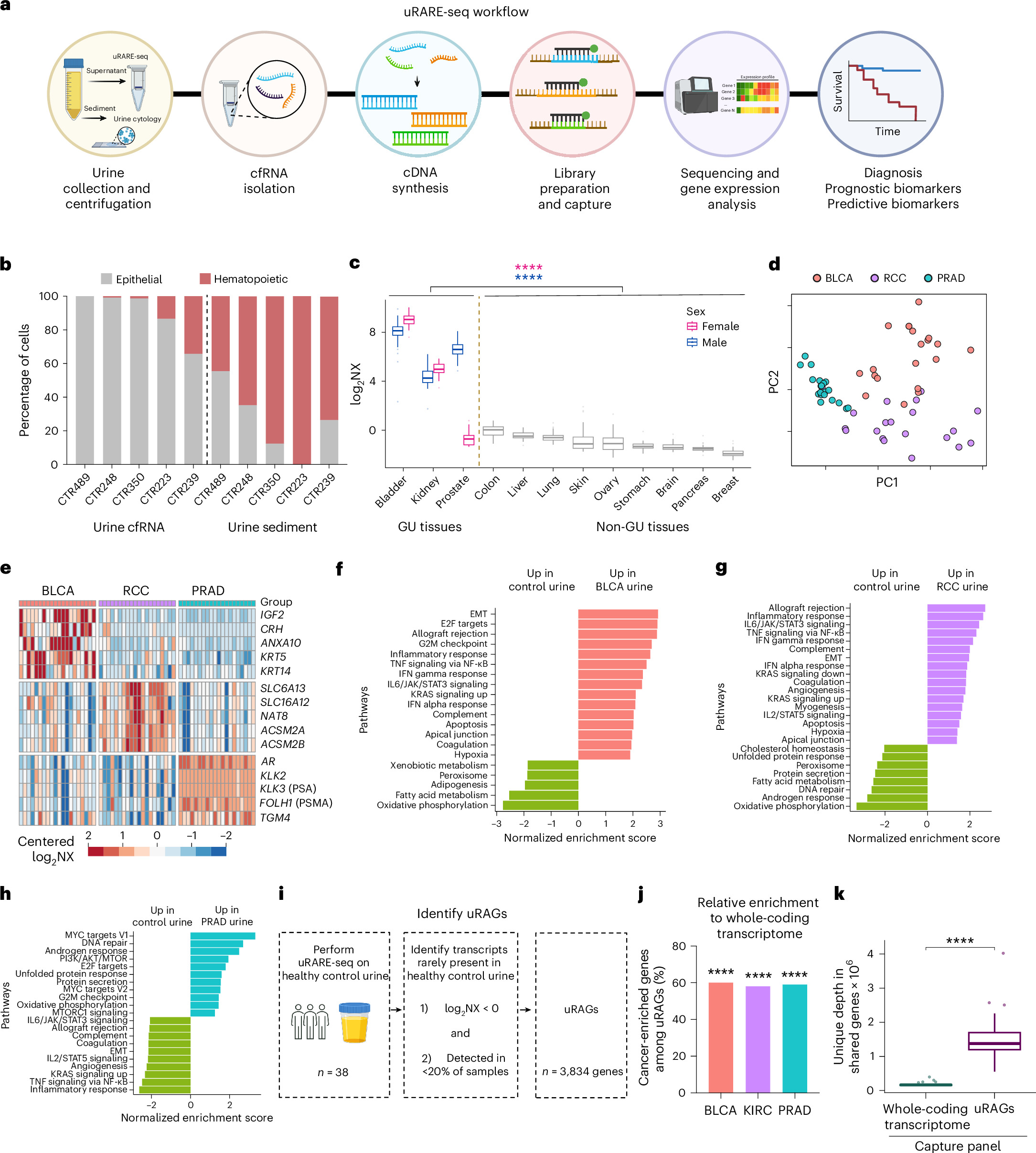
a, Schematic of the uRARE-seq workflow. b, CIBERSORTx gene expression deconvolution using epithelial and hematopoietic genes in paired control urine cfRNA and sediment samples (n = 5). c, Expression of gene signatures overexpressed in normal tissues in male (n = 31) and female (n = 17) healthy control urine cfRNA samples. Comparisons were performed using two-sided Student’s t test. Blue P value indicates comparison between male samples and pink P value represents comparison between female samples. ****P ≤ 2.2 × 10⁻¹⁶. d, Principal component analysis of whole transcriptome uRARE-seq data using urine samples from BLCA (n = 20), RCC (n = 20) and PRAD (n = 20) patients. e, Heatmap of urine cfRNA centered log2-transformed trimmed mean of M-values (TMM) gene expression values for genes known to be overexpressed in BLCA (n = 20), RCC (n = 20) or PRAD (n = 20) tumors. f,g,h, Hallmark gene set enrichment analysis of f, control (n = 48) versus BLCA (n = 20) urine cfRNA, g, control (n = 48) versus RCC (n = 20) urine cfRNA, and h, control (n = 48) versus PRAD (n = 20) urine cfRNA. Gene sets with adjusted P values ≤ 0.05 calculated using Benjamini–Hochberg (BH) multiple hypothesis correction are shown. i, Schematic of the process for defining uRAGs. j, Percentage of genes overexpressed in GU tumors that are included among uRAGs. Comparisons were performed using two-sided Fisher’s exact test. ****P = 0.00001. k, Comparison of unique sequencing depth for shared genes in uRARE-seq libraries captured with both whole-coding transcriptome and uRAG capture panels (n = 38 biological samples). Sequencing data were downsampled to achieve equivalent sequencing depth in all samples. Comparison was performed using paired two-sided Student’s t test. ****P < 2.2 × 10⁻¹⁶. In box plots, the center line denotes the median, the box contains the interquartile range (IQR) and the whiskers extend to 1.5× IQR. EMT, epithelial–mesenchymal transition; IFN, interferon; IL, interleukin; JAK, Janus kinase; MTOR, mechanistic target of rapamycin; NF-κB, nuclear factor kappa-light-chain-enhancer of activated B cells; STAT, signal transducer and activator of transcription; TNF, tumor necrosis factor; KIRC, kidney renal clear cell carcinoma.
High-accuracy approach
In a study of 683 urine samples from patients and healthy volunteers, the test correctly identified 95% of people with localized bladder cancer and gave a clean bill of health to 90% of those who did not, outperforming both standard urine cytology (in which urine is examined through a microscope to identify cancerous cells) and a DNA-based urine test. It also identified residual disease left behind after surgery and BCG immunotherapy.
The researchers found that patients who subsequently responded to BCG had pre-treatment urine RNA messages rich in genes involved in T-cell and immune-signaling activity; those who didn’t instead showed signs of rapidly dividing tumor cells. Leveraging this finding, they developed a biomarker that predicted with high accuracy whether tumors were more likely to respond to immunotherapy versus chemotherapy, which is currently a second-line treatment if BCG is not successful or is unavailable.
Identifying who is most likely to respond to BCG treatment is critical. BCG is manufactured by a single global supplier, and shortages are common, forcing urologists to ration it among patients. A validated version of the test could let doctors reserve BCG for those patients who are most likely to benefit from it and move others to chemotherapy sooner.
The researchers plan to validate uRARE-seq in larger, prospective trials at multiple centers, with the aim of bringing personalized treatment to bladder cancer patients.
“There are currently no biomarkers at all that are recommended or approved for surveillance. These treatments are incredibly taxing — physically and financially,” Liao said. “If we can guide those choices, we have the potential to help both patients and clinicians.”
Source – Stanford School of Medicine


Researchers developed a urine test that detects bladder cancer, predicts which patients will benefit from immunotherapy versus chemotherapy, and can confirm whether treatment worked.
simple urine test devised by researchers at Stanford Medicine and the VA Palo Alto Health Care System can diagnose people with bladder cancer more accurately than current standard methods. The test also allows physicians to not only assess the cancer’s response to treatment but to predict whether immunotherapy or chemotherapy is likely to be most effective for each patient.
The test is unique in that it measures RNA messages shed by tumor cells into urine, rather than hunting for cancer-related mutations in DNA as most blood and urine liquid biopsies do. Because RNA reflects which genes a cancer cell is actively using, it captures a tumor’s behavior in addition to its presence.
Diehn shares senior authorship of the study, which published Oct. 2 in Nature Medicine, with Joseph Liao, MD, the Kathryn Simmons Stamey Professor and chair of the department of urology, and Ash Alizadeh, MD, PhD, the Moghadam Family Professor. Graduate student Kevin J. Liu is the lead author of the research.
From blood to bladder
About 85,000 people in the United States are diagnosed each year with bladder cancer, which is prone to recurrence and expensive to monitor. Diagnosis and surveillance currently rely on cystoscopy, in which an endoscope is threaded into the bladder to look for suspicious tissue — a procedure that can miss up to 30% of cancer cases. High-risk patients with a history of non-muscle-invasive bladder cancer may need to undergo the surveillance procedure every three months.
After surgery to remove a tumor, many patients are treated with a weakened strain of the bacterium used in tuberculosis vaccines called Bacillus Calmette-Guérin, or BCG. BCG is instilled directly into the bladder through a catheter once a week for six weeks and may be repeated as maintenance for up to three years. BCG stimulates the patient’s immune system to destroy any lingering cancer cells. But the treatment doesn’t work for everyone — some tumors simply lack the underlying immune activity needed to spark an effective attack — and there’s been no reliable way to tell in advance who will benefit.
For more than a decade, Diehn and Alizadeh have collaborated on liquid biopsy technology, which involves testing blood and other types of fluids. In 2014, the pair developed CAPP-Seq (cancer personalized profiling by deep sequencing), a method for detecting trace amounts of tumor DNA in the blood of lung cancer patients and later showed it could also classify lymphoma subtypes and flag emerging drug resistance. They wondered whether a similar technique used on urine could enhance the diagnosis, monitoring and treatment of bladder cancer. But the bladder presented some unique challenges.
Normal bladder lining cells often accumulate their own mutations that overlap with those in a patient’s actual tumor. A DNA test can mistake these bystander mutations — known as the field effect — for cancer, and correcting for them often requires first sequencing a patient’s tumor and normal tissue to learn which mutations to track and which to disregard. In contrast, because RNA messages reflect overall gene activity rather than individual mutations, RNA tests don’t require matched tumor samples.
Designing a urine-based test focused on RNA rather than DNA, however, was difficult because RNA molecules in urine are fragmented and relatively rare. The researchers adapted a genetic sequencing method originally designed for RNA in blood plasma and designed a custom gene panel to identify RNA messages that are rare in healthy urine but abundant when a patient has genitourinary tumors. Applied to samples from patients with bladder, kidney and prostate cancer, the resulting test, called uRARE-seq (for urine random priming and affinity capture of cell-free RNA fragments for enrichment analysis by sequencing), closely tracked the biology of the tumors and could distinguish low-grade from high-grade bladder cancer.
Development and application of uRARE-seq for urine cfRNA analysis
a, Schematic of the uRARE-seq workflow. b, CIBERSORTx gene expression deconvolution using epithelial and hematopoietic genes in paired control urine cfRNA and sediment samples (n = 5). c, Expression of gene signatures overexpressed in normal tissues in male (n = 31) and female (n = 17) healthy control urine cfRNA samples. Comparisons were performed using two-sided Student’s t test. Blue P value indicates comparison between male samples and pink P value represents comparison between female samples. ****P ≤ 2.2 × 10⁻¹⁶. d, Principal component analysis of whole transcriptome uRARE-seq data using urine samples from BLCA (n = 20), RCC (n = 20) and PRAD (n = 20) patients. e, Heatmap of urine cfRNA centered log2-transformed trimmed mean of M-values (TMM) gene expression values for genes known to be overexpressed in BLCA (n = 20), RCC (n = 20) or PRAD (n = 20) tumors. f,g,h, Hallmark gene set enrichment analysis of f, control (n = 48) versus BLCA (n = 20) urine cfRNA, g, control (n = 48) versus RCC (n = 20) urine cfRNA, and h, control (n = 48) versus PRAD (n = 20) urine cfRNA. Gene sets with adjusted P values ≤ 0.05 calculated using Benjamini–Hochberg (BH) multiple hypothesis correction are shown. i, Schematic of the process for defining uRAGs. j, Percentage of genes overexpressed in GU tumors that are included among uRAGs. Comparisons were performed using two-sided Fisher’s exact test. ****P = 0.00001. k, Comparison of unique sequencing depth for shared genes in uRARE-seq libraries captured with both whole-coding transcriptome and uRAG capture panels (n = 38 biological samples). Sequencing data were downsampled to achieve equivalent sequencing depth in all samples. Comparison was performed using paired two-sided Student’s t test. ****P < 2.2 × 10⁻¹⁶. In box plots, the center line denotes the median, the box contains the interquartile range (IQR) and the whiskers extend to 1.5× IQR. EMT, epithelial–mesenchymal transition; IFN, interferon; IL, interleukin; JAK, Janus kinase; MTOR, mechanistic target of rapamycin; NF-κB, nuclear factor kappa-light-chain-enhancer of activated B cells; STAT, signal transducer and activator of transcription; TNF, tumor necrosis factor; KIRC, kidney renal clear cell carcinoma.
High-accuracy approach
In a study of 683 urine samples from patients and healthy volunteers, the test correctly identified 95% of people with localized bladder cancer and gave a clean bill of health to 90% of those who did not, outperforming both standard urine cytology (in which urine is examined through a microscope to identify cancerous cells) and a DNA-based urine test. It also identified residual disease left behind after surgery and BCG immunotherapy.
The researchers found that patients who subsequently responded to BCG had pre-treatment urine RNA messages rich in genes involved in T-cell and immune-signaling activity; those who didn’t instead showed signs of rapidly dividing tumor cells. Leveraging this finding, they developed a biomarker that predicted with high accuracy whether tumors were more likely to respond to immunotherapy versus chemotherapy, which is currently a second-line treatment if BCG is not successful or is unavailable.
Identifying who is most likely to respond to BCG treatment is critical. BCG is manufactured by a single global supplier, and shortages are common, forcing urologists to ration it among patients. A validated version of the test could let doctors reserve BCG for those patients who are most likely to benefit from it and move others to chemotherapy sooner.
Source – Stanford School of Medicine
Liu KJ, Shi WY, Nesselbush MC, Phillips NA, Mach KE, Luca B, Bajpai RK, Jabara I, Cheng JC, Sugio T, Shukla N, Shen EC, Koh IL, Wu DJ, Liu CL, Almanza D, Jun S, Tian F, Hamilton EG, Hoerner CR, Wang R, Esfahani MS, Hui A, La V, Holton G, Rodriguez G, Lee TJ, Ling X, Kalahasti N, Vallamkonda S, Mullane P, Chen SB, Shkolyar E, Prado K, Khaki AR, Chan E, Buyyounouski MK, Fan AC, Skinner EC, Alizadeh AA, Liao JC, Diehn M. (2026) Urine cell-free RNA for bladder cancer detection and treatment response prediction. Nature Medicine [Epub ahead of print]. [article]
Related Posts
UMIche – a UMI-centric analysis platform for enhancing molecular quantification accuracy in bulk and single-cell sequencing
New RNA sequencing tool reveals how stem cells develop into heart cells
Estimating the completeness of large-scale single-cell sequencing projects
New RNA sequencing tool improves transcriptome reconstruction using machine learning
DeMixNB: deconvolution of sparse-count RNA sequencing data for tumor cells
New RNA sequencing method improves tRNA analysis using deep learning
Researchers create first whole-body single-cell atlas of an adult vertebrate
UAlbany Joins $10 Million Effort to Map RNA Modifications in the Human Body
SpliceCOV improves RNA sequencing analysis by filtering transcriptional noise
Overlooked ‘off switch’ in lung tumors may explain why immunotherapy doesn’t work for everyone
Squids Edit RNA for Novel Protein Functions
New marker panel and web tool help define early human cell fates
RNA sequencing reveals molecular changes driving right ventricular heart failure
Researchers Develop AI Tool to Map MicroRNA Binding Sites on Circular RNAs
Single-cell RNA sequencing reveals the diversity of human neutrophils across health and disease
Recordanelles enable RNA sequencing to capture a history of gene activity in living cells
Yale researchers improve RNA extraction from precision-cut lung slices
RNA sequencing reveals how genes combine to regulate inflammation and immune responses
RNAffinityDB – a curated database of experimental RNA–protein binding affinities
“Raman Genome” for SARS-CoV-2: new Raman technology distinguishes viral variants by their molecular RNA architecture
Stay Connected
Submit a Post to the Blog
Recent Posts
Subscribe to the RNA-Seq Blog
RNA-Seq Products & Services