

Single-cell RNA sequencing (scRNA-seq) has become an essential tool for understanding the complexity of cells within tissues. It provides scientists with the ability to examine gene expression at the single-cell level, giving unprecedented insight into cellular heterogeneity. However, one challenge researchers face is the accurate classification of cell types based on gene expression patterns. Traditional methods for cell-type annotation rely on broad gene expression profiles, which often overlook specific gene interactions unique to individual cells.
Researchers from Tianjin University have developed a new algorithm called WCSGNet, which addresses this challenge. Unlike previous methods, WCSGNet uses a graph neural network approach that incorporates Weighted Cell-Specific Networks (WCSNs). These networks focus on highly variable genes and capture not only the gene expression patterns but also the gene association networks that are specific to each cell. This ability to integrate both gene expression and gene interaction features makes WCSGNet a more accurate tool for cell-type annotation.
The schematic overview of WCSGNet
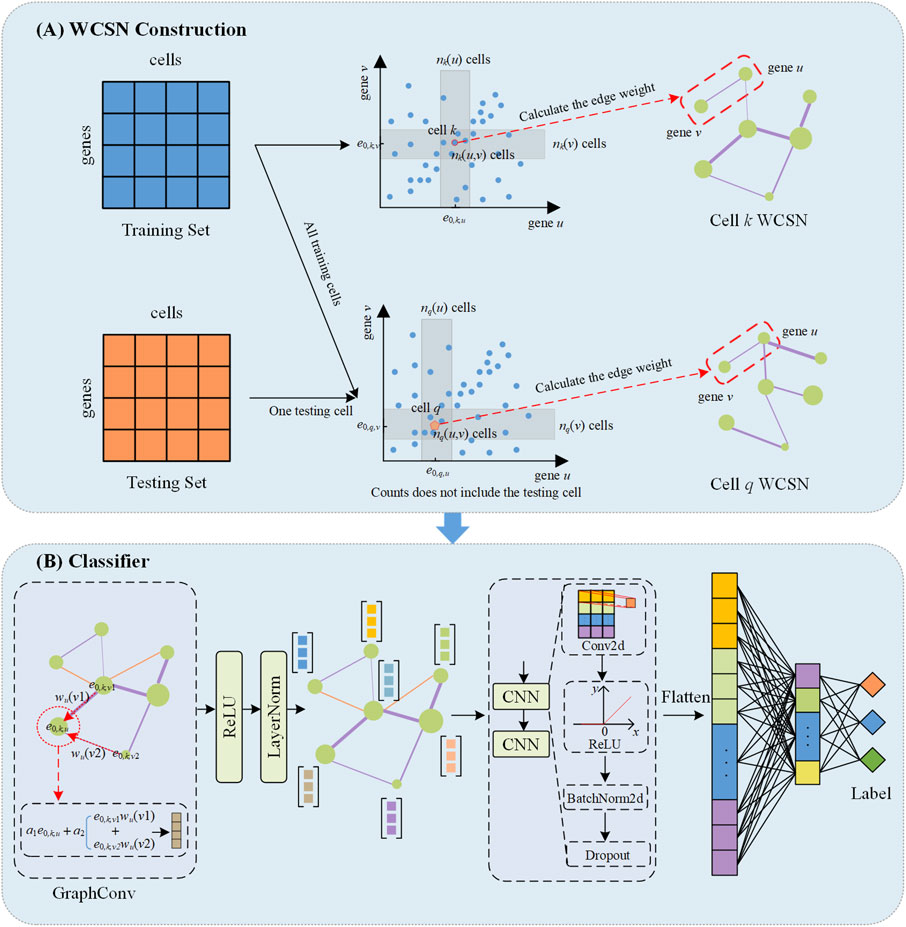
(A) Construction of weighted cell-specific gene association networks (WCSN). For the training set, WCSN is constructed based on independence tests among genes within the dataset. For the testing set, the construction of WCSN for each cell is based on the gene expression of the current cell and the training dataset. e0,k,u the expression value of the u-th gene in the k-th cell. Each gray area represents the neighborhood range of gene expression corresponding to the current cell. (B) The structure of the classifier. The GraphConv layer aggregates features of the current gene node with the interaction features of its neighboring nodes to generate an updated gene embedding. This is followed by Layer Normalization (LayerNorm) and a ReLU activation function. The processed embeddings are then passed through two convolutional layers (CNN) which include Conv2d, ReLU activation function, BatchNorm2d and Dropout. The CNN output is flattened, and two fully connected layers are subsequently applied to extract higher-level features, ultimately predicting the cell type labels.
What sets WCSGNet apart is its ability to maintain robust performance, especially with challenging imbalanced datasets. In numerous tests, the algorithm outperformed existing methods, providing superior stability and more precise classifications. The introduction of WCSGNet promises to improve the accuracy of cell-type identification in scRNA-seq studies, leading to more detailed insights into the complex molecular landscape of cells.
This advancement represents a significant step forward in single-cell analysis, where understanding the interactions between genes within individual cells is essential for unraveling complex biological processes.
Availability – All datasets and codes for reproducing this work were deposited in a GitHub repository: https://github.com/Yi-ellen/WCSGNet
Wang YR, Du PF. (2025) WCSGNet: a graph neural network approach using weighted cell-specific networks for cell-type annotation in scRNA-seq. Front Genet 16:1553352. [article]
Related Posts






Single-cell RNA sequencing (scRNA-seq) has become an essential tool for understanding the complexity of cells within tissues. It provides scientists with the ability to examine gene expression at the single-cell level, giving unprecedented insight into cellular heterogeneity. However, one challenge researchers face is the accurate classification of cell types based on gene expression patterns. Traditional methods for cell-type annotation rely on broad gene expression profiles, which often overlook specific gene interactions unique to individual cells.
Researchers from Tianjin University have developed a new algorithm called WCSGNet, which addresses this challenge. Unlike previous methods, WCSGNet uses a graph neural network approach that incorporates Weighted Cell-Specific Networks (WCSNs). These networks focus on highly variable genes and capture not only the gene expression patterns but also the gene association networks that are specific to each cell. This ability to integrate both gene expression and gene interaction features makes WCSGNet a more accurate tool for cell-type annotation.
The schematic overview of WCSGNet
(A) Construction of weighted cell-specific gene association networks (WCSN). For the training set, WCSN is constructed based on independence tests among genes within the dataset. For the testing set, the construction of WCSN for each cell is based on the gene expression of the current cell and the training dataset. e0,k,u the expression value of the u-th gene in the k-th cell. Each gray area represents the neighborhood range of gene expression corresponding to the current cell. (B) The structure of the classifier. The GraphConv layer aggregates features of the current gene node with the interaction features of its neighboring nodes to generate an updated gene embedding. This is followed by Layer Normalization (LayerNorm) and a ReLU activation function. The processed embeddings are then passed through two convolutional layers (CNN) which include Conv2d, ReLU activation function, BatchNorm2d and Dropout. The CNN output is flattened, and two fully connected layers are subsequently applied to extract higher-level features, ultimately predicting the cell type labels.
What sets WCSGNet apart is its ability to maintain robust performance, especially with challenging imbalanced datasets. In numerous tests, the algorithm outperformed existing methods, providing superior stability and more precise classifications. The introduction of WCSGNet promises to improve the accuracy of cell-type identification in scRNA-seq studies, leading to more detailed insights into the complex molecular landscape of cells.
This advancement represents a significant step forward in single-cell analysis, where understanding the interactions between genes within individual cells is essential for unraveling complex biological processes.
Availability – All datasets and codes for reproducing this work were deposited in a GitHub repository: https://github.com/Yi-ellen/WCSGNet
Wang YR, Du PF. (2025) WCSGNet: a graph neural network approach using weighted cell-specific networks for cell-type annotation in scRNA-seq. Front Genet 16:1553352. [article]
Related Posts
Recent Posts
 Machine learning reveals how RNA splicing is regulated in individual cell types
 Illumina releases SpliceAI2 to help advance rare disease research
 Postdoctoral Fellow – Long-Read RNA Methods Development for Neurodegeneration
 Novel biosensor uses DNA ‘barcodes’ to uncover disease signals in cells
 GP-DHT uses single-cell RNA sequencing to map gene regulatory networks
 Boehringer taps Envisagenics’ AI to mine RNA splicing for cancer targets
RNA-Seq Products & Services



Stay Connected