

Understanding how genes work and affect an organism’s traits is a big goal in biology. One powerful way to do this is by looking at transcriptomes, which are the complete sets of RNA molecules made in cells. RNA tells us which genes are active and how they change when genes are turned on or off. Scientists want to study these changes for every gene in a living animal, but that has been very difficult until now.
Researchers at the University of Massachusetts Medical School developed a new method called Worm Perturb-Seq, or WPS. This technique combines the genetics of a tiny worm called Caenorhabditis elegans with advanced RNA sequencing technology. What makes WPS special is that it can measure the effects of hundreds of gene knockdowns all at once, in living worms, with very high detail.
Worm Perturb-Seq (WPS) overview
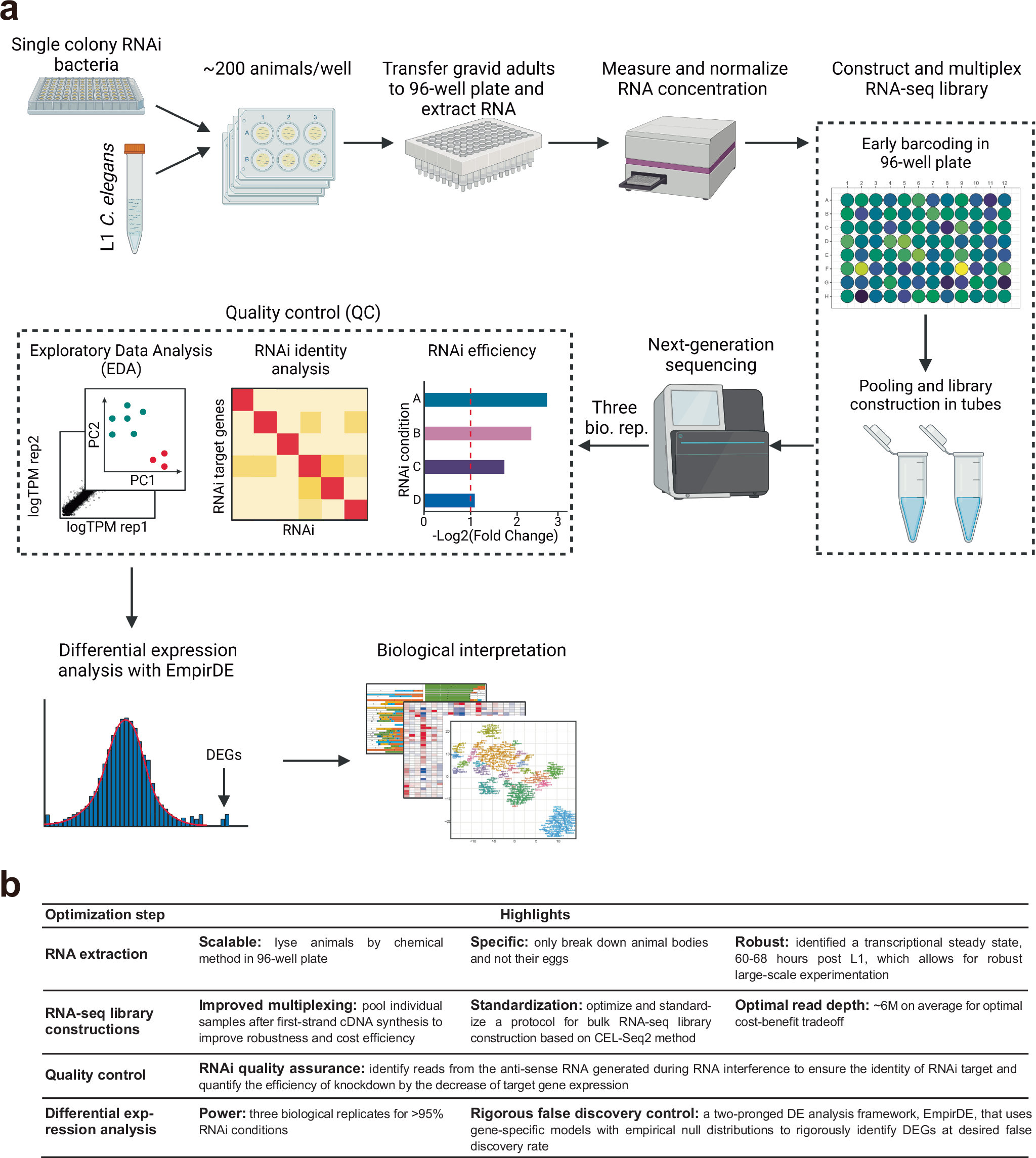
The researchers also created a new analysis tool called EmpirDE, which uses the huge amount of data generated to identify changes in gene expression with better accuracy. Using WPS, they studied 103 nuclear hormone receptors and found that many of these receptors work together in pairs to regulate the same genes. This discovery shows the complex ways genes interact in living animals.
Worm Perturb-Seq promises to be useful not just for worm research, but also for studying other organisms, including human cells. It opens the door for faster and more comprehensive studies of how genes shape biology.
Availability – The WPS data analysis pipeline is available at our GitHub repository [https://github.com/XuhangLi/WPS]
Zhang H, Li X, Song D, Yukselen O, Nanda S, Kucukural A, Li JJ, Garber M, Walhout AJM. (2025) Worm Perturb-Seq: massively parallel whole-animal RNAi and RNA-seq. Nat Commun 16(1): 4785. [article]
Related Posts




Understanding how genes work and affect an organism’s traits is a big goal in biology. One powerful way to do this is by looking at transcriptomes, which are the complete sets of RNA molecules made in cells. RNA tells us which genes are active and how they change when genes are turned on or off. Scientists want to study these changes for every gene in a living animal, but that has been very difficult until now.
Researchers at the University of Massachusetts Medical School developed a new method called Worm Perturb-Seq, or WPS. This technique combines the genetics of a tiny worm called Caenorhabditis elegans with advanced RNA sequencing technology. What makes WPS special is that it can measure the effects of hundreds of gene knockdowns all at once, in living worms, with very high detail.
Worm Perturb-Seq (WPS) overview
The researchers also created a new analysis tool called EmpirDE, which uses the huge amount of data generated to identify changes in gene expression with better accuracy. Using WPS, they studied 103 nuclear hormone receptors and found that many of these receptors work together in pairs to regulate the same genes. This discovery shows the complex ways genes interact in living animals.
Worm Perturb-Seq promises to be useful not just for worm research, but also for studying other organisms, including human cells. It opens the door for faster and more comprehensive studies of how genes shape biology.
Availability – The WPS data analysis pipeline is available at our GitHub repository [https://github.com/XuhangLi/WPS]
Zhang H, Li X, Song D, Yukselen O, Nanda S, Kucukural A, Li JJ, Garber M, Walhout AJM. (2025) Worm Perturb-Seq: massively parallel whole-animal RNAi and RNA-seq. Nat Commun 16(1): 4785. [article]
Related Posts
Recent Posts
 Machine learning reveals how RNA splicing is regulated in individual cell types
 Illumina releases SpliceAI2 to help advance rare disease research
 Postdoctoral Fellow – Long-Read RNA Methods Development for Neurodegeneration
 Novel biosensor uses DNA ‘barcodes’ to uncover disease signals in cells
 GP-DHT uses single-cell RNA sequencing to map gene regulatory networks
 Boehringer taps Envisagenics’ AI to mine RNA splicing for cancer targets
RNA-Seq Products & Services



Stay Connected