

RNA molecules can be chemically altered after they are produced, a process known as RNA editing. One of the most common forms is adenosine-to-inosine, or A-to-I, editing, which can influence RNA processing, stability, and gene regulation without changing the underlying DNA sequence.
Researchers at the Guangzhou Medical University investigated whether different RNA sequencing technologies affect measurements of A-to-I RNA editing.
The team compared short-read next-generation sequencing with long-read cDNA RNA sequencing in HEK293T and U2OS human cell lines. They found that short-read RNA sequencing consistently produced lower estimates of A-to-I editing than long-read sequencing. Full-length amplicon sequencing supported the long-read measurements.
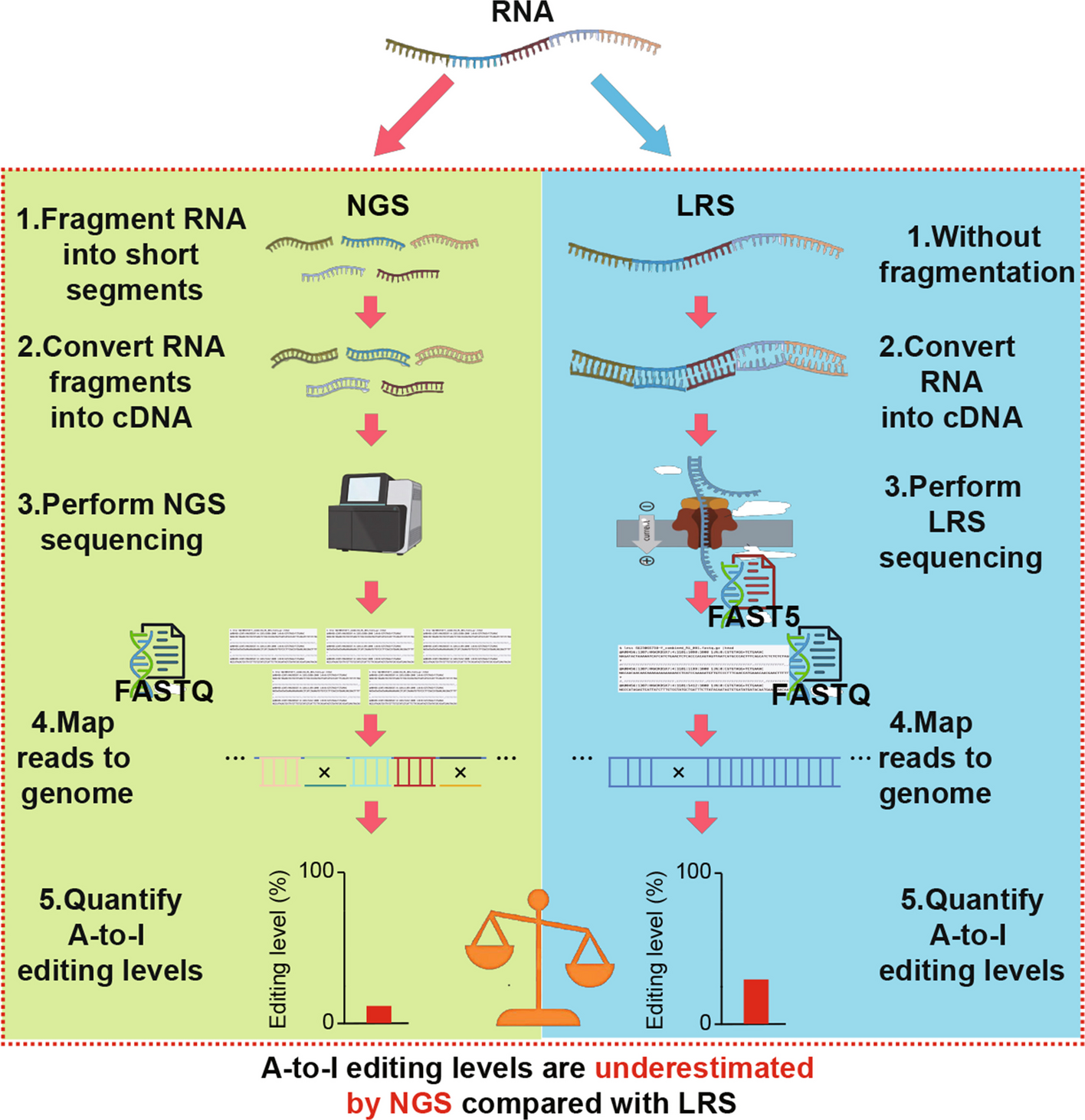
Schematic diagram of A-to-I editing level underestimated by NGS compared with LRS RNA-seq
Why read length matters
Short-read sequencing generates relatively small pieces of sequence that must be aligned to a reference genome. When sequences originate from similar or repetitive genomic regions, shorter reads can be difficult to place accurately.
The researchers found that edited short reads were more likely to map to multiple locations or fail to map at all. Losing these edited reads during alignment can lower the calculated level of A-to-I editing.
Longer reads contain more surrounding sequence information, making it easier to determine their correct genomic location and potentially providing more accurate measurements of RNA editing.
The researchers also analyzed public short-read and long-read RNA sequencing datasets from several human cancer cell lines. The same pattern appeared across these datasets, with short-read sequencing generally producing lower estimates of A-to-I editing. They also found that measured editing levels tended to increase as sequencing read length increased.
Implications for RNA editing research
A-to-I RNA editing is involved in many aspects of RNA biology and has been investigated in cancer, neurological disease, immune responses, and other conditions. If sequencing technology systematically affects editing measurements, researchers could mistake technical differences for biological ones.
The findings are especially important when comparing RNA sequencing datasets produced using different technologies or read lengths.
Short-read RNA sequencing remains valuable for many applications, but when accurate measurement of A-to-I RNA editing is the main goal, long-read sequencing may offer an advantage. By improving sequence alignment, longer reads can provide a more complete picture of this important layer of RNA regulation.
Cheng S, Qi Y, Ya J, Xia L, Zhang W, Xiong Q, Liu Q, Zhang J, Song Y. (2026) Short-read RNA-seq yields lower estimates of A-to-I RNA editing levels than long-read cDNA sequencing. Advanced Biotechnology 4(3): 27.[article]
Related Posts




RNA molecules can be chemically altered after they are produced, a process known as RNA editing. One of the most common forms is adenosine-to-inosine, or A-to-I, editing, which can influence RNA processing, stability, and gene regulation without changing the underlying DNA sequence.
Researchers at the Guangzhou Medical University investigated whether different RNA sequencing technologies affect measurements of A-to-I RNA editing.
The team compared short-read next-generation sequencing with long-read cDNA RNA sequencing in HEK293T and U2OS human cell lines. They found that short-read RNA sequencing consistently produced lower estimates of A-to-I editing than long-read sequencing. Full-length amplicon sequencing supported the long-read measurements.
Schematic diagram of A-to-I editing level underestimated by NGS compared with LRS RNA-seq
Why read length matters
Short-read sequencing generates relatively small pieces of sequence that must be aligned to a reference genome. When sequences originate from similar or repetitive genomic regions, shorter reads can be difficult to place accurately.
The researchers found that edited short reads were more likely to map to multiple locations or fail to map at all. Losing these edited reads during alignment can lower the calculated level of A-to-I editing.
Longer reads contain more surrounding sequence information, making it easier to determine their correct genomic location and potentially providing more accurate measurements of RNA editing.
The researchers also analyzed public short-read and long-read RNA sequencing datasets from several human cancer cell lines. The same pattern appeared across these datasets, with short-read sequencing generally producing lower estimates of A-to-I editing. They also found that measured editing levels tended to increase as sequencing read length increased.
Implications for RNA editing research
A-to-I RNA editing is involved in many aspects of RNA biology and has been investigated in cancer, neurological disease, immune responses, and other conditions. If sequencing technology systematically affects editing measurements, researchers could mistake technical differences for biological ones.
The findings are especially important when comparing RNA sequencing datasets produced using different technologies or read lengths.
Short-read RNA sequencing remains valuable for many applications, but when accurate measurement of A-to-I RNA editing is the main goal, long-read sequencing may offer an advantage. By improving sequence alignment, longer reads can provide a more complete picture of this important layer of RNA regulation.
Cheng S, Qi Y, Ya J, Xia L, Zhang W, Xiong Q, Liu Q, Zhang J, Song Y. (2026) Short-read RNA-seq yields lower estimates of A-to-I RNA editing levels than long-read cDNA sequencing. Advanced Biotechnology 4(3): 27.[article]
Related Posts
Recent Posts
 Single Cell Discoveries Acquires TATAA Biocenter to Create an End-to-End Precision Biology CRO
 qMAP reveals RNA fragmentation patterns linked to development and disease
 Urine microRNAs may help distinguish bacterial from viral infections in children
 Benchmarking RNA sequencing for more accurate alternative splicing analysis
 RNA Sequencing identifies new tick-borne virus that causes flu-like illness
 Eclipsebio expands its RNA characterization capabilities with multi-attribute nanopore-based sequencing assay eSTRAND RNA QC™
RNA-Seq Products & Services



Stay Connected